
Mount Koya (Koyasan) | Complete Guide to Transportation, Attractions, and Itineraries
Located in Wakayama Prefecture, Mount Koya (Koyasan) was originally founded by the Buddhist monk Kobo Daishi (Kukai) as a sacred center for monastic training. Over 1,200 years of history, Mount Koya has evolved into one of Japan's most revered religious sanctuaries and a UNESCO World Heritage site. Renowned for its magnificent temple architecture, rich heritage, and serene mountain vistas, it has naturally become a premier travel destination. Many independent travelers take day trips or overnight stays to Mount Koya departing from Osaka and throughout the Kansai region.
In this guide, I will walk you through trains, cable cars, local bus networks, must-see sights, temple lodging (shukubo) experiences, and sample day-trip itineraries to help you explore this mystical mountain haven!

1. How to Get to Mount Koya (Koyasan)?
Aside from renting a car and driving, traveling to Mount Koya relies primarily on the Nankai Electric Railway. Most travelers board trains from Osaka's Nankai Namba or Tengachaya Station down to Gokurakubashi Station, then transfer directly to the Nankai Koyasan Cable Car up to the terminal station, Koyasan Station.

Trains bound for Mount Koya depart approximately every 20 to 30 minutes. Most are Express trains (taking around 2 hours and 10 minutes from downtown Osaka to Mount Koya), while Limited Express trains depart roughly once an hour and take about 1.5 hours. For outbound departures, consult the Namba Station Timetable and Tengachaya Station Timetable. For your return trip, check the Koyasan & Gokurakubashi Station Timetable. If boarding from other stations, refer to the full Nankai Electric Railway Timetable.
Regarding fares, departing from Nankai Namba Station costs around ¥1,400 one-way on Express trains and around ¥2,200 on Limited Express trains, making a round trip cost roughly ¥3,000 to ¥4,000+. That is why many travelers opt for discount passes, such as the Nankai All Line 2-Day Pass (¥2,000) offering unlimited rides on Nankai lines, or the Koyasan World Heritage Ticket (¥3,080), which covers round-trip train travel between Osaka Namba and Koyasan Station plus unlimited rides on Koyasan local buses, saving you a substantial amount on transportation.
If you prefer to save time planning transit and sightseeing logistics, organized tours like this Mount Koya Day Tour or Mount Koya Day Tour (Departing from Osaka) are great alternatives with reasonable prices and tour support. For more Kansai transit discount passes, check out my Osaka Transportation Guide.


(Upon arriving at Gokurakubashi Station via the Nankai line, there is no need to exit the ticket gates. Simply take a 1-minute walk along the transfer corridor to the cable car platform; the ride up to the terminal Koyasan Station takes about 5 minutes.)


(The cable car connecting Gokurakubashi to Koyasan features a unique stepped cabin layout designed for the steep gradient. Mount Koya sits at an elevation of roughly 1,000 meters, offering picturesque alpine scenery throughout the ascent.)
2. Getting Around Mount Koya
Once you arrive atop Mount Koya, local transportation is very straightforward. The mountain is served primarily by Nankai Rinkan Bus, operated by the same Nankai group, connecting all prominent sights. While several routes operate on the plateau, the vast majority run back and forth between Koyasan Station, Okunoin, and Daimon Gate. Routes venturing outside this main corridor run infrequently and are rarely needed by typical travelers.
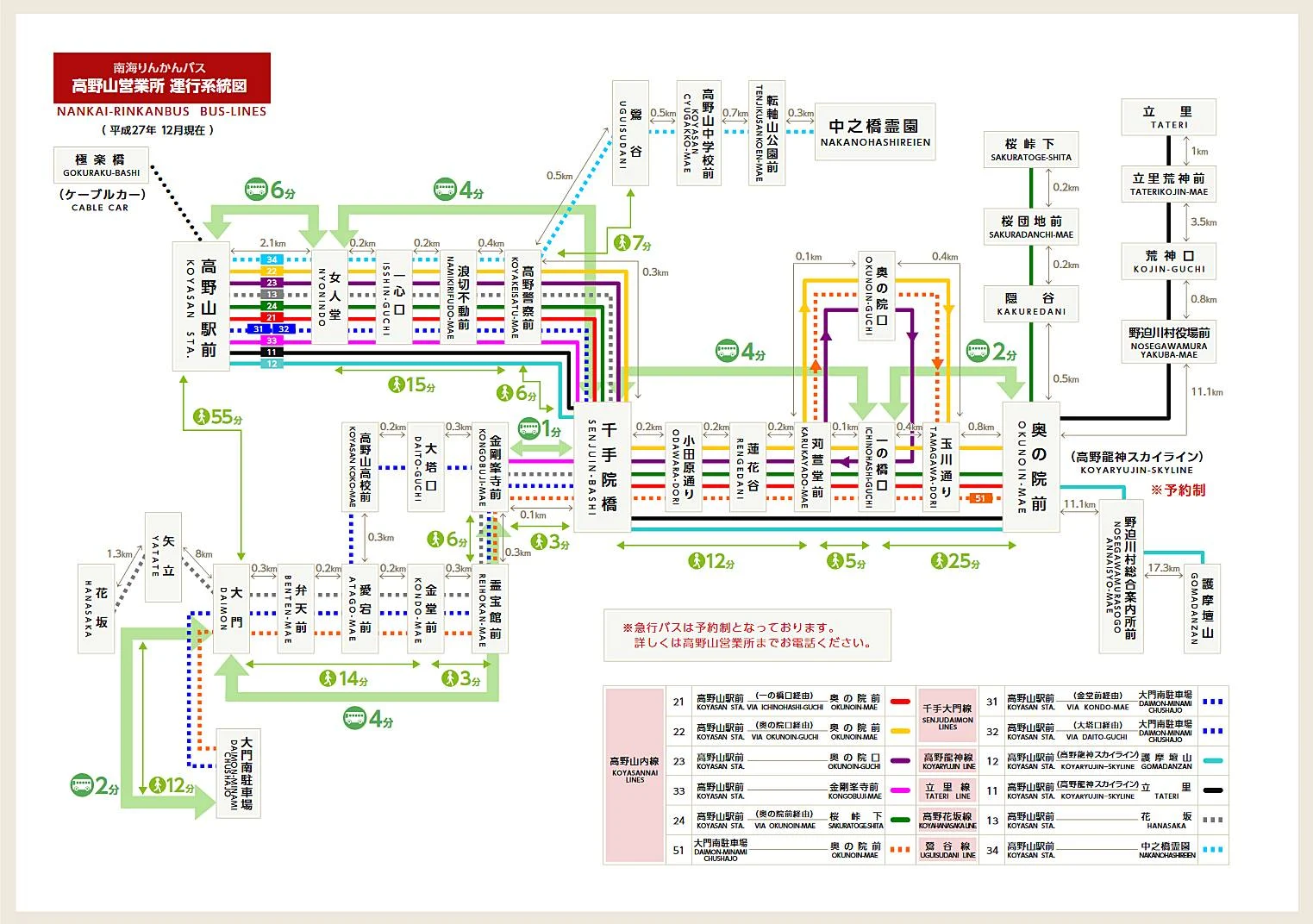
(Detailed departure times can be found on the Koyasan Bus Timetable. As seen on the route map, Senjuinbashi Station serves as the central transfer nexus for all bus lines, making its surrounding neighborhood the most convenient hub for dining and shopping.)

(Here is a consolidated bus route map. Because most services circulate along this identical main spine, this simplified visual is much easier to navigate.)
Single bus fares start at ¥220 for adults and ¥110 for children, increasing by distance. However, buying single tickets is strongly discouraged. Instead, pick up the Koyasan Bus 1-Day Pass (¥840 for adults / ¥420 for children), which provides unlimited rides across all Mount Koya bus lines and pays for itself in just 3 trips. Since visiting the scattered attractions easily requires more than three rides, this pass is practically essential.
As you can see, if you already plan to ride the Nankai line and use local buses, the previously mentioned Koyasan World Heritage Ticket (¥3,080) offers by far the best overall value, cutting your transit expenses significantly for both single-day and two-day excursions.


(Koyasan Station is a charming, historic building. The second floor houses a small exhibition hall introducing Mount Koya's history, Buddhist culture, and attractions, alongside a cozy observation lounge overlooking the mountain valley.)

(Right outside Koyasan Station exits is the bus concourse where all lines originate. The 1-Day Bus Pass must be purchased at the ticket counter here, as online purchasing is currently unavailable. Platform 2 serves buses bound for Okunoin, while Platform 3 serves buses heading toward Daimon Gate.)

(When using the Koyasan Bus 1-Day Pass, simply flash it to the driver upon disembarking. The pass also includes tear-off discount coupons for admission to key temples and local restaurants, trimming down your on-mountain expenses even further.)

(Similar to the Osaka City Bus, Kyoto City Bus, and Nara Bus, onboard digital screens clearly display upcoming stops and corresponding fare stages in multiple languages.)
3. Top Attractions in Mount Koya
Now that you know how to navigate the mountain, let's explore the must-see sights of Mount Koya! Originally founded by Kobo Daishi (Kukai), this sacred temple community is the cradle of Shingon Esoteric Buddhism. The settlement is cradled by eight surrounding peaks, resembling an unfolding eight-petaled lotus flower—a revered Buddhist symbol of auspicious harmony, earning the plateau its title, Hachiyo no Mine (The Eight-Petaled Peaks).
During its peak in the Edo period (1603–1868), Mount Koya boasted more than 2,000 temple halls. Today, 117 active temples remain, maintaining an imposing, deeply spiritual atmosphere throughout the forested plateaus. Among these, three landmarks stand out as absolute essentials: Okunoin, Danjo Garan, and Kongobu-ji.

1. Okunoin (おくのいん)
Okunoin is not only the crown jewel of Mount Koya but is universally regarded as the most sacred sanctuary on the entire mountain. A tranquil 2-kilometer stone-paved approach winds past more than 200,000 moss-covered gravestones, memorial stupas, the Eireiden Hall, the legendary Sweat-Drenched Jizo (Asekaki Jizo), and the Sugatami Well. The path culminates at Gobyobashi Bridge and the Mausoleum of Kobo Daishi (Kobo Daishi Gobyo), where Kukai is believed to rest in eternal meditation, offering visitors an unforgettable encounter with Japanese Buddhist spirituality.
◎ Address: 550 Koyasan, Koya-cho, Ito-gun, Wakayama Prefecture (Okunoin)
◎ Access: Take the Nankai Rinkan Bus from Koyasan Station and get off at "Okunoin-mae" or "Ichinohashi-guchi"
◎ Official Website: Mount Koya Okunoin Official Website
◎ Nearby Accommodations: Booking.com | Agoda | Hotels.com | Expedia (Compare Rates)


(Okunoin was our very first stop. I personally recommend structuring your day this way: ride the bus straight to the terminus at Okunoin in the morning, then work your way back toward the town center for a smoother itinerary.)


(Walking through the cedar forest from the Okunoin trailhead, you will pass monuments dedicated to legendary warlords, feudal lords, literary giants, performing artists, and modern corporate founders, testifying to Okunoin's peerless spiritual stature in Japan.)

(Passing the Eireiden Memorial Hall, the canopy of multi-hued autumn leaves was breathtaking. Like seasonal highlights around Kyoto attractions and Nara attractions, Mount Koya displays dramatically distinct charm throughout the four seasons.)


(Approaching Gobyobashi Bridge, you will find a row of bronze statues known as the Mizukake Jizo, where worshipers ladle water over them in prayer, alongside a pavilion offering omamori amulets, goshuin stamps, and memorial items.)

(Once crossing Gobyobashi Bridge into the inner sanctum of Kobo Daishi's Mausoleum, all photography and filming are strictly forbidden, so I am sharing an event poster here. The interior is profoundly solemn and far larger than I envisioned, comprising prayer spaces, the lantern-filled Torodo Hall, and the Shotokuden Hall. Leaving this ground brings an extraordinary sense of inner tranquility!)
2. Danjo Garan (だんじょうがらん)
Danjo Garan is the primary monastic training ground (Nemoto Dojo) established by Kobo Daishi when he first consecrated Mount Koya. Standing alongside Okunoin as one of the two great holy sites of Mount Koya, it is an indispensable stop. The sacred compound houses numerous pagoda halls and temples, with the most celebrated highlights being Konpon Daito, Kondo Hall, Chumon Gate, and the Sanko no Matsu (Three-Needle Pine).
◎ Address: 152 Koyasan, Koya-cho, Ito-gun, Wakayama Prefecture (Danjo Garan)
◎ Access: Take the Nankai Rinkan Bus from Koyasan Station and get off at "Kongobuji-mae" or "Kondo-mae"
◎ Official Website: Koyasan Danjo Garan Official Website

(The premier landmark of Danjo Garan is the Konpon Daito Great Pagoda. Initiated by Kobo Daishi and finished by his successor, this towering 50-meter structure enshrines four large Buddha statues alongside century-old esoteric Buddhist frescoes. While interior photography is prohibited, stepping inside is an unforgettable aesthetic experience.)

(Facing Konpon Daito is Kondo Hall, the main hall where monks hold significant rituals and daily monastic devotions. It houses invaluable murals and enshrines Yakushi Nyorai, the Medicine Buddha.)


(The Chumon Gate is another architectural marvel in Danjo Garan. Originally built in 819 and faithfully reconstructed following a devastating fire, it enshrines the statues of the Four Heavenly Kings: Dhritarashtra, Vaisravana, Virudhaka, and Virupaksha.)
3. Kongobu-ji Temple (金剛峯寺)
Shingon Buddhism oversees more than 4,000 affiliated temples throughout Japan, and Kongobu-ji serves as the Head Temple (Sohonzan) of the entire sect, explaining its unrivaled prestige. Chief highlights include exquisite fusuma sliding-door paintings, historic temple kitchens, and Banryutei—the largest dry rock garden in Japan. History buffs can also view the room where Toyotomi Hidetsugu committed ritual suicide. The refined timber craftsmanship makes this temple a must-visit.
◎ Address: 132 Koyasan, Koya-cho, Ito-gun, Wakayama Prefecture (Kongobu-ji)
◎ Admission: Adults ¥500; Elementary students ¥200
◎ Access: Take the Nankai Rinkan Bus from Koyasan Station and alight at "Kongobuji-mae"
◎ Official Website: Koyasan Kongobu-ji Official Website


([Photo by 663highland via Wikimedia Commons])
4. Senjuinbashi Area & Other Attractions


(As mentioned earlier, the Senjuinbashi bus junction is where all principal routes meet, making it the most accessible area on the mountain. Consequently, charming local restaurants, souvenir boutiques, Buddhist art shops, and smaller sub-temples gather here. Most visitors break for lunch here, and strolling along the sidewalks is delightful.)


(Throughout Mount Koya's shopping streets, you will encounter the famous local specialty sweet, Karukaya Mochi. Naturally, I picked some up to sample. The texture resembles soft mochi with a delicate, understated sweetness—refreshing and very reasonably priced. Be sure to try it when you visit!)


(If you have ample time, Koyasan features additional worthwhile cultural spots like the Reihokan Museum, the monumental Daimon Gate, Kongosammai-in Temple, Nyonindo (Women's Hall), and the Tokugawa Mausoleum. Visiting all of them on a day trip can be tight, but an overnight 2-day itinerary allows you to explore them at a leisurely pace.)
4. Mount Koya Accommodations (Shukubo Experience)
While a day trip to Mount Koya is completely feasible, staying overnight is deeply rewarding for independent travelers. Accommodations here are truly unique; rather than Western-style hotels, visitors stay in temple lodgings known as Shukubo. Guests can savor Buddhist vegetarian cuisine (shojin ryori), relax in communal baths, and participate in morning meditation, sutra copying (shakyo), and dawn prayer ceremonies. If you crave an authentic cultural immersion, consult this List of Koyasan Shukubo (Temple Lodgings) to reserve your stay for an extraordinary experience!
◎ Find Accommodations: Booking.com | Agoda | Hotels.com | Expedia (Compare Rates)
That concludes my guide to Mount Koya's transportation, top attractions, recommended itineraries, and temple lodgings. While Mount Koya maintains an unpretentious, quiet atmosphere, its spiritual aura and pristine nature left a profound impression on me. Next time you travel around Kansai, do not miss the chance to wander through this unforgettable mountaintop sanctuary!