
Shuri Castle — A Must-Visit Attraction in Naha.
Before 1879, the Ryukyu Kingdom ruled the islands for over 450 years, cultivating a rich and distinctive culture. At the heart of its political and economic life stood Shuri Castle. Today, Shuri Castle, along with neighboring World Heritage sites such as Tamaudun and the Sonohyan-utaki Stone Gate, forms Shurijo Castle Park—an essential destination that no traveler to Okinawa should miss!
In this post, I will introduce the top 4 must-visit attractions in and around Shurijo Castle Park: Shuri Castle, Tamaudun, Sonohyan-utaki Stone Gate, and Kinjo-cho Stone-Paved Road. Let's take a stroll together and soak in the rich historical atmosphere of the Ryukyu Kingdom!

(The grand courtyard in front of Shuri Castle's Main Hall is known as the "Una," where grand state ceremonies and celebrations were once held. The alternating red and white stripes on the ground served a distinct purpose: they guided civil and military officials to line up in their designated places during ceremonies, while the central red-tiled path, called the "Ukidou," was reserved exclusively for the king and high-ranking envoys.)

(Shurijo Castle Park covers a fairly expansive area, but the visiting route is very well-planned, though there are several slopes and stone stairs along the way. You can admire each important historic landmark in sequence, taking about 1.5 hours for a leisurely tour.)
◎ Shuri Castle & Sonohyan-utaki Stone Gate
Here, the historic cultural fusion with Chinese architecture feels even more pronounced.
Shuri Castle’s architectural craftsmanship and techniques are truly one-of-a-kind, particularly its exquisite stone-masonry work, which stands as a precious cultural treasure. An Okinawan friend once explained to me that the biggest difference between castle ruins in Okinawa (gusuku) and those on mainland Japan is that Okinawan castles are never strictly rectangular or square. Instead, the fortress walls curve and follow the natural contours of the undulating terrain, much like topographic lines on an elevation map. Later, as I explored other Okinawan castle ruins such as Zakimi Castle Ruins and Nakijin Castle Ruins, I found this was indeed true. It is truly a remarkable World Heritage experience to witness firsthand!
♁ Address: 1-2 Shuri Kinjo-cho, Naha City, Okinawa Prefecture (MAPCODE: 33 161 497*55)
♁ Admission: Adults 400 JPY; High School Students 300 JPY; Elementary/Junior High Students 160 JPY; Children Free (Discounts with Monorail Pass)
* Same-day re-entry is permitted once if you notify staff and receive a hand stamp upon exit.
♁ Transportation: Take Bus No. 1, 7, 8, 14, or 17 and get off at "Shurijo-koen-iriguchi" followed by a 5-minute walk; or take the Yui Rail monorail to "Shuri Station" and walk about 15 minutes (Monorail Guide | Bus Guide | Car Rental & Driving Guide)
♁ Official Website: Shuri Castle
♁ Nearby Accommodation: Booking︱Agoda︱Hotels︱Expedia (Compare Rates | Recommended Hotels)
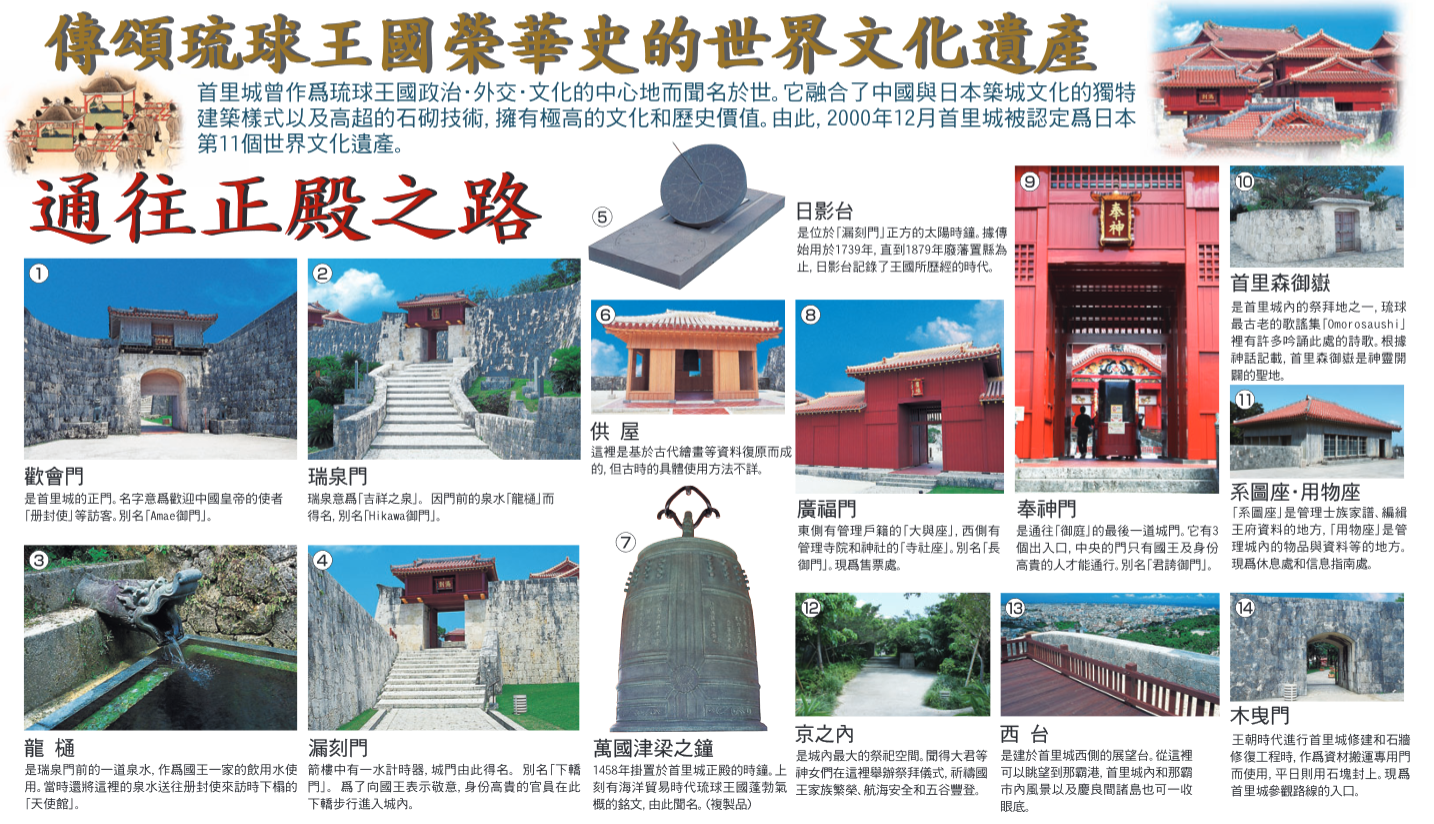
(On your way toward the Main Hall of Shuri Castle, you will pass numerous historical relics. A particularly noteworthy item is the "Bankoku Shinryo no Kane" (Bridge of Nations Bell). The term "Bankoku Shinryo" means "a bridge connecting all nations," describing how the Ryukyu Kingdom utilized its prime maritime location as a pivotal trading hub between nations. There is even a dedicated Bankoku Shinryokan convention hall in central Okinawa. Note that the bell currently hanging at Shuri Castle is an exact replica; the original historic bell is carefully preserved at the Okinawa Prefectural Museum.)


(Reaching the Main Hall requires some effort, as you must pass through several impressive gates in sequence, including Kankaimon, Zuisenmon, and Rokokumon. It reminds you how difficult it must have been in ancient times to secure an audience with the Ryukyu king!)


(The ticket counter is located just outside the grand "Una" courtyard; upon entering, you are greeted by majestic dragon pillars and stone Shisa guardian statues.)

(Upon entering the palace interior, photography is prohibited throughout the first exhibition sections, which showcase delicate porcelains, imperial scrolls, and fine artifacts—so you'll just have to capture those treasures with your eyes! Visitors are also required to take off their shoes; plastic shoe bags are handed out by staff at the entrance. Photography is permitted again in the later sections, where you can see the royal throne, imperial plaques bestowed during the Qing Emperor Kangxi era, and distinctly Chinese-influenced palace motifs—showcasing just how profound ancient China's cultural influence was on the Ryukyu Kingdom.)

(This iconic gate is an absolute must-photograph landmark in Shurijo Castle Park! In ancient times, the diplomatic relations between the Ryukyu Kingdom and imperial China were closer than those with mainland Japan, leaving clear marks of Chinese architectural elegance throughout the grounds. The plaque atop this gate reads "Shurei no Kuni" (The Land of Propriety), a title conferred by the Chinese Emperor to the Ryukyu vassal kingdom.)

(The Sonohyan-utaki Stone Gate sits just behind the Shureimon Gate. In ancient times, whenever the Ryukyu king departed the castle on an official tour or pilgrimage, he would stop here to offer prayers for a safe and prosperous journey.)

(Around the perimeter of the Shuri Castle Main Hall area lie Benzaitendo and Enkanchi Pond, an artificial pond complex constructed in 1502. The small arched bridge is called "Tennyobashi" (Angel Bridge), modeled after traditional camelback arched bridges of southern China, adorned with lotus relief carvings along its stone balustrades.)

(Because Shuri Castle stands atop an elevated hill, several lookout points provide panoramic views over Naha City.)
◎ Tamaudun
What else is there to see around Shurijo Castle Park?
Tamaudun, alongside Shuri Castle, Shikinaen, Zakimi Castle Ruins, and Nakijin Castle Ruins, is designated as part of Okinawa's UNESCO World Heritage site collection. Situated just a short stroll outside Shuri Castle, it is also known as "Tama-udun" or "Rei-udun." It served as the royal mausoleum for the Second Sho Dynasty of the Ryukyu Kingdom and stands as the largest stone-chamber tomb (hafu-style) in Okinawa. While most of the structures were carefully reconstructed after World War II, the site retains immense historical dignity. Nearby stands the "Tower of First Middle School Youths," erected in memory of students from Okinawa Prefectural First Middle School who lost their lives during the Battle of Okinawa.
♁ Address: 1-3 Shuri Kinjo-cho, Naha City (MAPCODE: 33 160 659*77)
♁ Admission: Adults 300 JPY; Children 150 JPY (Discounts with Monorail Pass)
♁ Transportation: Take City Bus No. 1, 14, or 17, or Outer Bus No. 46 to "Shurijo-koen-iriguchi" (Shurijo Castle Park Entrance) and walk about 5 minutes; or take the Yui Rail to Shuri Station or Gibo Station and walk about 15 minutes (Monorail Guide | Bus Guide | Car Rental & Driving Guide)
♁ Official Website: Tamaudun
♁ Check Accommodation: Booking︱Agoda︱Hotels︱Expedia (Compare Rates | Recommended Hotels)

(Although Tamaudun is situated right next to the bustling Shuri Castle, visitor crowds here are noticeably sparser. It is a more compact World Heritage site in Okinawa, conveying a quiet, dignified, and serene solemnity.)

(Next to the ticket office, there is an exhibition room displaying excavated burial relics and historical records.)

(Regarding this photo, I want to share a touching little story. It was a scorching sunny day around noon when heatstroke could easily hit. I noticed a groundskeeper sweeping the sandy coral ground in front of Tamaudun, which was already spotless and free of any debris. I asked him what he was doing, and he explained that he was gently raking neat, parallel ridges with his bamboo broom—not only for aesthetics, but to break up the harsh glare of direct sunlight reflecting off the white sand into visitors' eyes. I asked him, "Won't you have to do this all over again as soon as people walk through?" He smiled and replied, "Then I'll just do it again!" I was the only traveler there at that moment; nobody was watching him, and most visitors would never even realize the thoughtfulness behind it. I paused, reflected deeply on his dedication, and thanked him with all my heart!)
◎ Kinjo-cho Stone-Paved Road & Shuri Castle Surroundings
Wait, there's even more right next to Shurijo Castle Park!
The Shuri Kinjo-cho Stone-Paved Road is a designated Historic Site of Okinawa Prefecture and has been selected as one of Japan's Top 100 Historic Roads. Paved with weathered Ryukyuan limestone, the road originally stretched for nearly 10 kilometers, though wartime destruction reduced it to the preserved 240-meter path seen today. The flanking stone walls are built using Okinawa’s traditional stone-fitting technique called "Aigata-tsumi." As you wander through this neighborhood, you will immediately notice the deep, authentic Ryukyuan charm: the red-tile roofs and century-old trees around you carry hundreds of years of living history. If your schedule allows, taking a quiet walk down this stone path offers a truly unique and enriching travel experience.
♁ Address: 2-chome Shuri Kinjo-cho, Naha City, Okinawa Prefecture (Shuri Kinjo-cho Stone-Paved Road)
♁ Admission: Free
♁ Transportation: Take Bus No. 7 or 8 and alight at "Ishidatami-iriguchi" (Detailed Guide | Car Rental & Driving Guide)
♁ Check Accommodation: Booking︱Agoda︱Hotels︱Expedia (Compare Rates | Recommended Hotels)


(The peaceful streetscapes around Shurijo Castle Park and Kinjo-cho Stone-Paved Road offer a soothing contrast to downtown Naha. Though it is a modest residential neighborhood today, its historic charm and old-world character are immediately felt as soon as you step onto the cobblestones.)

(Because the terrain across Shurijo Castle Park sits atop high ground, there are several observation decks beyond the main hall where you can enjoy sweeping panoramic views over Naha City! [Extended Reading: Okinawa Night View Spots])
That concludes my guide and travel diary for Shuri Castle, its World Heritage monuments, and the surrounding neighborhood! This is an essential stop for virtually every traveler to Okinawa, and it's also a wonderful place to slow down and wander at your own pace. Next time you visit Naha, be sure to set aside ample time to immerse yourself in this unique Ryukyuan heritage!
If you enjoy culturally rich Okinawa attractions like these, other spots such as Ryukyu Mura, Okinawa World Culture Kingdom, Okinawa Prefectural Museum & Art Museum, Naha City Museum of History, Peace Memorial Park, and the Former Japanese Navy Underground HQ Park are also fantastic choices that I highly recommend adding to your itinerary!