
Okinawa Monorail: Ultimate Guide to Routes, Fares, and Discount Passes
Can you explore Naha City without renting a car?
Naha's urban monorail, officially named the "Okinawa Urban Monorail" or "Yui-Rail (ゆいレール)," is an elevated monorail line connecting Naha City with surrounding districts, and is currently the only railway line in Okinawa Prefecture.
Riding this monorail line easily connects you to top Naha attractions like Kokusai Dori, Shurijo Castle, and Omoromachi (Shintoshin). It is also the most seamless way to travel from Naha Airport straight into downtown. When paired with Naha City buses, you can reach virtually any of the premier Naha attractions. So visiting Naha without renting a car is completely doable and convenient!
Below, I have put together a comprehensive guide detailing ticket purchasing tutorials, route maps, fare tables, and cost-saving transit passes for the Naha Yui Rail monorail. I hope this helps you plan your Okinawa trip smoothly!

(Unlike many other Japanese prefectures, Okinawa does not have an underground subway system; instead, an elevated straddle-beam monorail glides across the city center.)
1. Monorail Route & Fares
There is currently only 1 single monorail line, running simply between Naha Airport Station and Tedako-Uranishi Station as the two termini. Every station platform clearly indicates trains bound for Naha Airport or Tedako-Uranishi Station. The complete route map and fare breakdown are shown below:

(Route and station map of the monorail. In operation since 2003, even after the extension beyond Shuri Station to Tedako-Uranishi in 2019, it remains one single line. A one-way end-to-end journey takes just 38 minutes.)

(Fare table and inter-station travel times for the Naha monorail. Numbers in parentheses indicate child fares for ages 6–12. Children under 6 ride free, though if traveling with 3 or more young children, child fares apply starting from the 3rd child. Adult one-way fares start at 250 yen and scale by distance. Please check the official website for any updates.)

(Every Okinawa monorail platform features clear directional overhead signs.)
2. How to Buy Tickets & Ride the Monorail
Much like subways and metro stations worldwide, Okinawa monorail station entrances are equipped with automatic ticket vending machines and network maps. When passing through the ticket gates, simply place the QR code printed on your ticket face-down onto the scanner sensor. The official tutorial diagram shows you how it works—whether using an OKICA card or a paper QR ticket, the process is practically identical: red light stops, blue light passes!

(Here is the official quick guide on buying and using monorail tickets. It is straightforward and very easy for first-time visitors to pick up.)

(Ticket machines are located right near station entrances, and station attendants are always nearby if you need assistance.)

(Walk through once the indicator lights turn blue/green.)
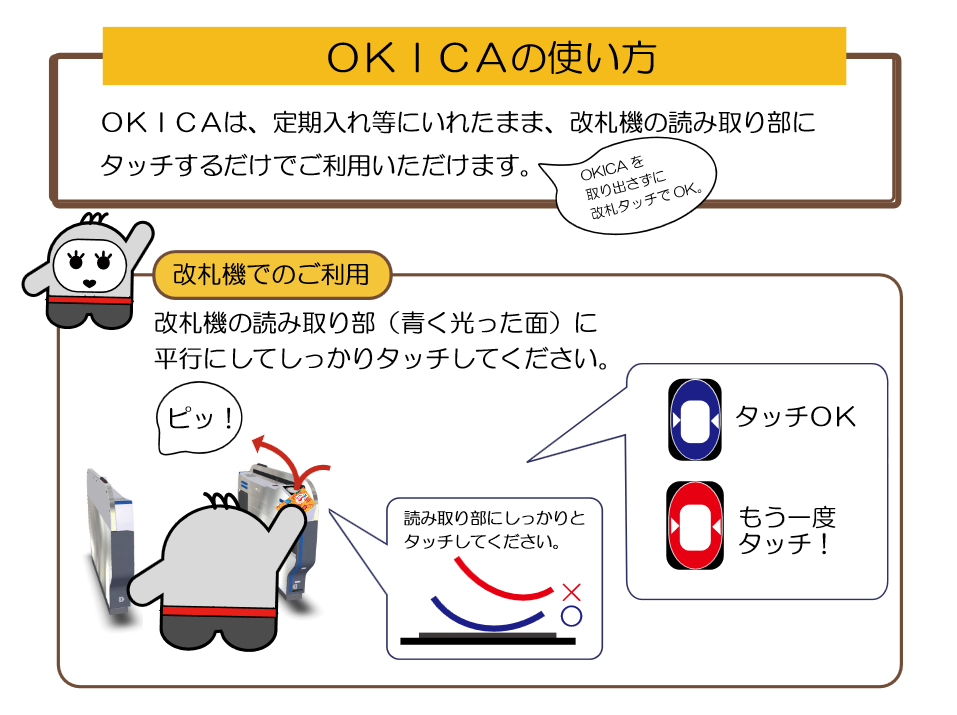
(OKICA is Okinawa's regional contactless smart card. At ticket gates, it works just like regular paper tickets: tap the card on the IC pad, or align the QR code face-down toward the scanner reader.)

(I find the Okinawa monorail platforms charming and compact, offering clear, accessible transit information.)

(Station platforms display clear timetables; trains usually arrive every 5 to 10 minutes.)

(Okinawa monorail trains typically consist of just two cars—so cute they almost feel like theme park rides! Remember that eating and drinking are prohibited onboard, and platform signs encourage keeping phone conversations to a minimum.)

(Okinawa monorail stations are relatively compact. While some lack downward escalators, barrier-free elevators are always available whenever needed!)
3. Ticket Types & Discount Passes
Currently, there are 4 main ticketing options: Standard Single Tickets, 1-Day / 2-Day Passes, Commuter Passes, and IC Cards. Commuter passes are primarily designed for local daily commuters and won't be covered here. Below are the key ticket types useful for travelers:
1. Standard Single Ticket (Regular Fare)
Single-ride tickets with fares detailed in the chart above.

(Single paper tickets are quite small and must be scanned when both entering and exiting stations, so be careful not to misplace yours!)
2. 1-Day & 2-Day Passes
Enjoy unlimited rides on the monorail for 24 hours or 48 hours from initial activation. Priced at 1,000 yen and 1,800 yen respectively (half-price for children), taking roughly 3 or more rides makes it pay for itself. In addition, ticket holders can receive up to 20% off admission at selected attractions!

(Monorail day passes feature multilingual instructions and have the exact expiration timestamp printed on them. Unlike subway passes in some other Japanese cities, Okinawa's 1-Day and 2-Day passes operate on a rolling 24-hour and 48-hour basis, which makes them extremely valuable when planned thoughtfully across two calendar days.)

(A generous list of sightseeing discounts comes with your 1-Day and 2-Day passes—typically around a 20% discount on admission fees at popular Naha venues such as Shurijo Castle, Tamaudun, Shikinaen Garden, the Okinawa Prefectural Museum & Art Museum, the Naha City Museum of History, the Tsushima-maru Memorial Museum, and the Former Japanese Navy Underground Headquarters. Visiting several of these spots within the pass's validity can save substantial travel cash, plus there are dining and shopping perks to explore!)
3. IC Cards (OKICA & Nationwide Transit Cards)
OKICA is Okinawa's regional smart transit card, similar to Taiwan's EasyCard or Hong Kong's Octopus card. Initial purchase options are 1,000 / 2,000 / 3,000 / 4,000 / 5,000 / 10,000 yen (including a 500 yen refundable deposit), and top-ups require 1,000 yen increments. It offers speed and points rebate bonuses when crossing certain monthly spending thresholds (see chart below), and is accepted on Okinawa buses. However, for short leisure stays in downtown Naha, buying a 1-Day or 2-Day pass is almost always more cost-effective!

(OKICA monthly usage rebate points calculation chart)

(Okinawa Yui Rail now accepts all major nationwide Japanese IC transit cards, including Suica, ICOCA, Pasmo, and nimoca.)
4. Credit Card Contactless Payment
As an added convenience, starting March 28, 2025, Okinawa Monorail supports contactless open-loop payment with credit, debit, and prepaid cards (including Visa, Mastercard, JCB, and American Express), making city travel even smoother for international tourists.
Please note: When using contactless bank cards, all passengers (adults and children alike) are billed at the adult standard fare. However, there is currently a daily fare cap: maximum daily charges are capped at 800 yen per calendar day, essentially serving as an 800-yen "day pass." Keep in mind that this cap resets at midnight each day, differing fundamentally from the 24-hour rolling window of the official 1-Day Pass. If your trip spans two calendar days within a 24-hour window (or if traveling with children), purchasing a traditional 24-Hour Pass may still prove more economical—so pick according to your itinerary!

(When tapping a contactless credit card, look for the card reader positioned slightly below the standard IC touch pad on the gate.)
That wraps up my comprehensive guide to the Okinawa Monorail! I personally love riding the Yui Rail—it's a great spot to meet fellow travelers and local residents, leaving me with many warm memories. I hope you enjoy gazing out over Naha's vibrant urban scenery from above, and have a wonderful adventure of your own!


(Traversing the heart of Naha, the monorail serves as an indispensable lifeline for locals and travelers alike.)

(This is Omoromachi Station, one of Naha's largest monorail hubs, connecting directly to the Shintoshin commercial shopping district featuring popular retail malls like San-A Naha Main Place and the T Galleria by DFS duty-free complex. It is also one of the few stations with dual platforms, so make sure to check your direction before boarding!)