
Kyoto Subway | Ultimate Guide & Day Passes
Unlike Osaka, where the subway forms the primary backbone of city transit, Kyoto relies predominantly on buses, with the subway acting as a complementary transit network. Although Kyoto's subway network has far fewer lines compared to Osaka, it cuts directly through the city center and connects key attractions, making it a fantastic, traffic-free option for travelers to master.
In this guide, I'll walk you through Kyoto subway route maps, timetables, fares, and the top 6 discount transit passes to help make your travels around Kyoto smooth and stress-free!

1. Kyoto Subway Basics & Overview
The Kyoto Subway is operated by the Kyoto Municipal Transportation Bureau (often called Kyoto City Subway). Currently, there are only two lines: the Tozai Line (east-west) and the Karasuma Line (north-south).
On official route maps, you might notice two colored thin lines extending from the subway network. These indicate through-service trains (tracks shared with private railways so passengers don't need to transfer). However, these extended segments do not belong to Kyoto City Subway, meaning separate fares apply, so keep that in mind when calculating ticket costs.

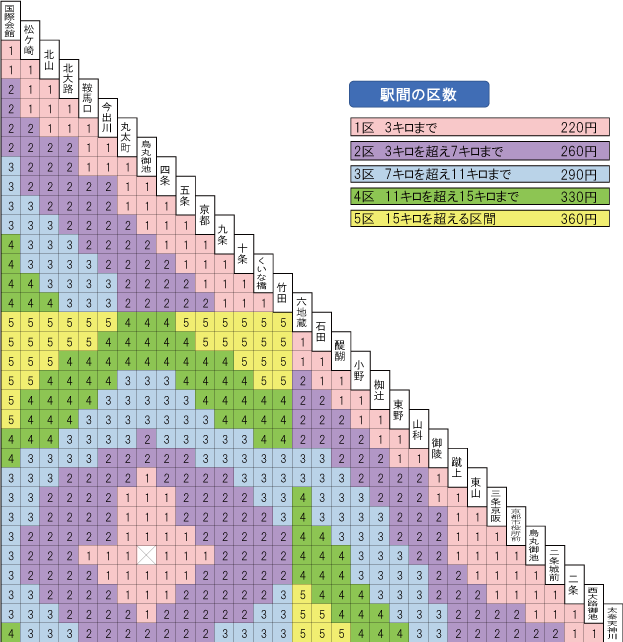
Kyoto subway trains operate daily from around 5:30 AM to midnight, running every 5 to 10 minutes. Fares are calculated by zone (divided into Zones 1 through 5), ranging from 220 to 360 yen. You can check the detailed fare breakdown on the official zone fare table.

(In addition to purchasing single-journey paper tickets at ticket machines, the Kyoto Subway supports all major Japanese IC transportation cards, including ICOCA, Suica, Pasmo, and nimoca.)
2. Top 6 Kyoto Subway Discount Passes Compared
Here is a comprehensive breakdown of the various travel passes usable on the Kyoto Subway. Each pass covers different geographic zones and transit systems, so you can pick the perfect one based on your itinerary.
1. Subway 1-Day Pass (Kyoto City Subway One-Day Pass)
Offers unlimited rides on all Kyoto Subway lines for a single day, plus special admission discounts at around 10 major Kyoto attractions.
◎ Price: Adults 800 JPY; Children 400 JPY
◎ Where to Buy: Ticket counters at any Kyoto Subway station, automated ticket machines inside subway stations, Kyoto City Bus and Subway Information Centers, and Commuter Pass Sales Counters

If the sights on your daily itinerary are located conveniently near subway stations, or if you are traveling to terminal stations like Rokujizo or Takeda, this pass is ideal. It pays for itself after just 3 subway rides. However, if your journey also requires city buses, the Subway & Bus 1-Day Pass described below is generally a much better deal.
2. Subway & Bus 1-Day Pass
Provides unlimited one-day travel on all Kyoto Subway lines, Kyoto City Bus routes within designated zones, Kyoto Bus, Keihan Bus, and West Japan JR Bus routes, alongside discounts at around 60 tourist spots, facilities, and shops.
◎ Price: Adults 1,100 JPY; Children 550 JPY
◎ Where to Buy: Kyoto City Bus and Subway Information Centers, Commuter Pass Sales Counters, and aboard City Buses (supplies on buses are very limited and often sell out, so buying at subway stations is recommended)

This pass offers tremendous value and breaks even after roughly 4 to 5 bus or subway trips. Since the formerly popular Kyoto Bus One-Day Pass has been discontinued, this card is now the premier pass for navigating the Kyoto bus network. Combining bus flexibility with subway speed allows you to reach virtually all Kyoto city attractions while skipping road traffic jams—making it an absolute must-have for sightseers.
3. Kyoto Subway & Randen 1-Day Pass
Provides unlimited one-day travel on all Kyoto Subway lines as well as the entire Randen (Keifuku Electric Railroad) network (Arashiyama Main Line and Kitano Line).
◎ Price: Adults 1,300 JPY (no child fare available)
◎ Where to Buy: Kyoto Subway station ticket windows, City Bus & Subway Information Centers, Commuter Pass Sales Counters, and Randen stations (Shijo-Omiya, Arashiyama, Kitano-Hakubaicho, Katabiranotsuji)
◎ Money-Saving Tip: Booking online via Klook frequently offers discounts and saves time waiting in ticket lines.

This pass is perfect if you plan on hopping around central Kyoto via subway and heading out to Arashiyama, Kitano Tenmangu, and surrounding northwestern areas aboard the scenic Randen tramway on the same day.
4. Nara & Ikaruga 1-Day Ticket (Kyoto City Transportation Bureau Edition)
Grants unlimited one-day rides on all Kyoto Subway lines, designated Kintetsu Railway sections connecting Osaka Namba, Nara, Kyoto, and Tsutsui, as well as designated Nara Kotsu bus routes, plus discounts at around 50 sights, shops, and attractions.
◎ Price: Adults 2,200 JPY (no child fare available)
◎ Where to Buy: Kyoto Subway station ticket counters, City Bus & Subway Information Centers, and Commuter Pass Sales Counters

While this pass covers the Kyoto Subway, its core benefit lies in long-distance travel into Nara or Osaka. Unless you plan to journey from Kyoto to Nara, Tsutsui, and downtown Osaka in a single day with multiple intermediate rail trips, standard single tickets or an IC card may be more economical.
5. Kurama & Kibune 1-Day Ticket
Offers unlimited single-day travel on all Kyoto Subway lines, the Keihan Main Line (Sanjo Station to Demachiyanagi Station), and all Eizan Railway lines, plus admission discounts at around 15 shrines, temples, and shops.
◎ Price: Adults 2,000 JPY (no child fare available)
◎ Where to Buy: Kyoto Tourist Information Center (Kyo Navi), City Bus & Subway Information Centers, Eizan Railway Demachiyanagi Station, and Kansai Tourist Information Center Kyoto

If you are merely doing a straightforward round-trip between downtown Kyoto and Kurama/Kibune, buying individual fares is cheaper. However, if you plan to combine Kurama and Kibune with stops along the Eizan line or even explore Mount Hiei on the same day, this pass becomes very cost-effective.
That concludes our guide to the Kyoto Subway! As you can see, discount passes involving the subway cater to distinct geographical regions—whether you are sticking purely within downtown Kyoto, making excursions to Kurama or Nara, or venturing across the wider Kansai area. Choose the one that matches your daily itinerary best, and enjoy your journey through Kyoto!