
Dazaifu Tenmangu Shrine | Transport, Sights & Itinerary Complete Guide
Fukuoka's "Dazaifu Tenmangu Shrine" serves as the head shrine (sohonsha) for over 12,000 Tenmangu shrines across Japan. Thanks to its distinguished spiritual standing, mouthwatering local eats, and stunning seasonal scenery, it has long been a quintessential must-visit destination for independent travelers. Almost everyone traveling to Fukuoka plans a half-day or full-day excursion to Dazaifu Tenmangu.
Today, I'll walk you through transportation options, street food, itineraries, and top nearby attractions around Dazaifu Tenmangu so you can grasp everything quickly and plan your perfect day trip effortlessly!

1. How to Get to Dazaifu
1. Nishitetsu Railway (Recommended)
Board the Nishitetsu Tenjin-Omuta Line (Limited Express or Express) from Nishitetsu Fukuoka (Tenjin) Station, transfer to the Nishitetsu Dazaifu Line at Nishitetsu Futsukaichi Station, and get off at Dazaifu Station. The journey takes about 30 minutes and costs 420 JPY, making it by far the most recommended option.

2. JR Train + Nishitetsu / Local Bus
If you're using a JR Kyushu Rail Pass and want to save some cash, take the JR train from Hakata Station to JR Futsukaichi Station, walk about 15 minutes to Nishitetsu Futsukaichi Station, and then take the Dazaifu Line to Dazaifu Station. The total trip takes roughly 70 minutes, with the Nishitetsu portion costing 170 JPY. It saves a little bit of money, but it is quite time-consuming.
Alternatively, take the JR line from Hakata Station to JR Tofuro-Minami Station, and transfer to the Dazaifu Community Bus ("Mahoroba-go") to Dazaifu Station (requires a bus change at Nishitetsu Tofuro-mae Station). The entire journey takes around 55 minutes, with the Mahoroba bus fare totaling 200 JPY (a 1-day bus pass is also available, detailed below).

3. Direct Bus
Take the direct Nishitetsu "Tabito" bus from Hakata Bus Terminal straight to Dazaifu Station. The trip takes about 45 minutes and costs 600 JPY. Because it is slower and pricier than taking the train, few travelers opt for the bus unless they carry a valid bus pass.


Finally, if you prefer hassle-free planning without worrying about train transfers, booking an organized day tour is a great alternative! Popular options include the Dazaifu & Yanagawa Combo Ticket, the Dazaifu Tenmangu, Yufuin & Beppu Hells 1-Day Tour, the Dazaifu Bus Day Tour, and the Dazaifu Tenmangu & Oita 1-Day Tour. They offer reasonable pricing, comfortable coaches, and dedicated guides!
2. Getting Around Dazaifu City
Whether arriving by train or bus, once you step out of Dazaifu Station, you can easily reach Dazaifu Tenmangu Shrine on foot. You only need local transportation if you plan to explore other surrounding attractions.
Local transit within Dazaifu is operated by the Community Bus, officially named "Mahoroba-go" (まほろば号). Operating much like a sightseeing bus, it connects all major cultural and historical sights across Dazaifu City. Regardless of travel distance, fares are flat at 100 JPY per ride. You can also use a Northern Kyushu / All Kyushu SUNQ PASS or buy the "Mahoroba-go 1-Day Pass" for 300 JPY for unlimited rides within a day.
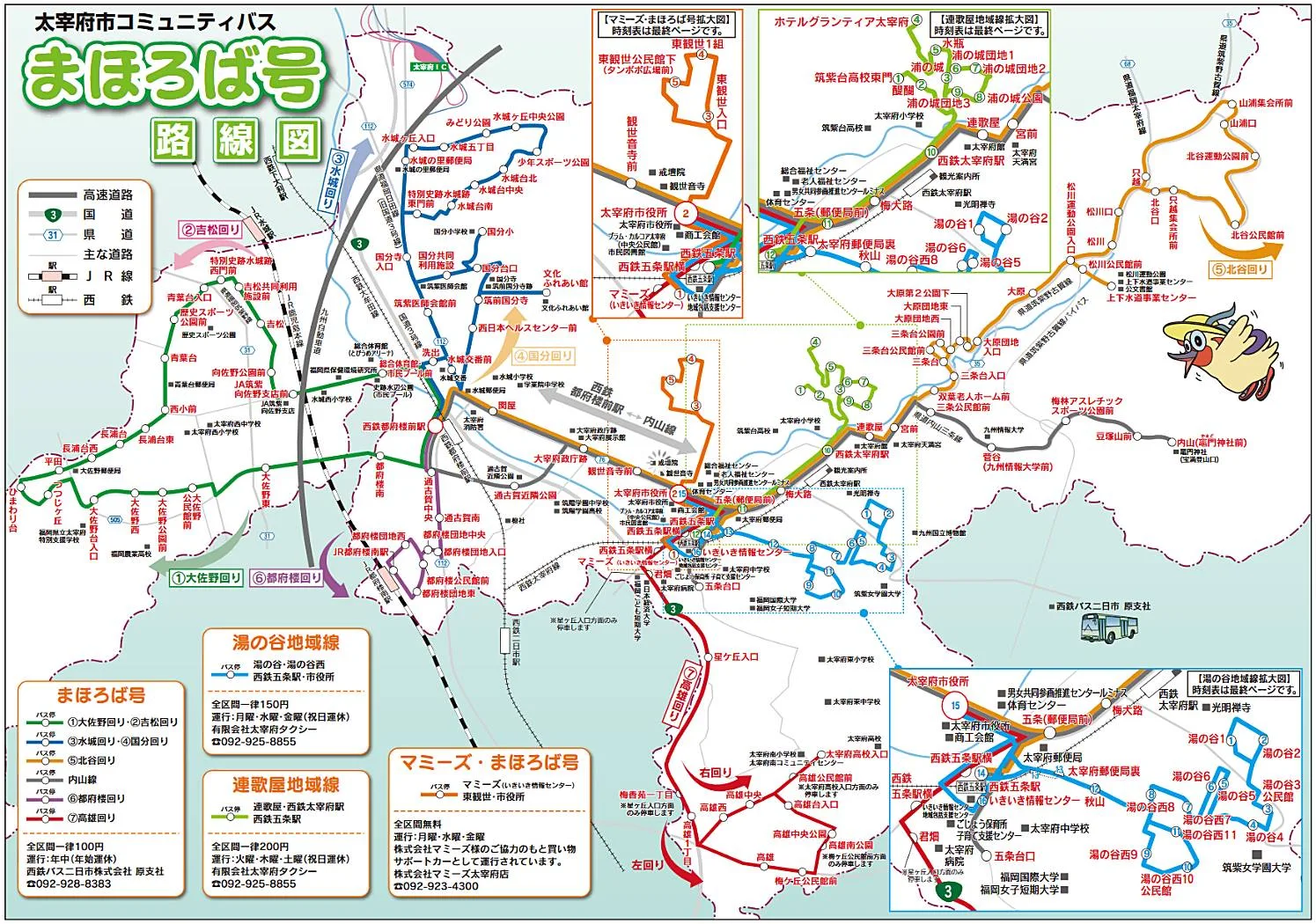
(Complete network map of the "Mahoroba-go" community bus in Dazaifu, covering all essential sights across the city—ideal for in-depth exploration. Timetables can be checked on the official Mahoroba-go Information Guide.)

(Since we planned to visit other sights around town besides Dazaifu Tenmangu, we purchased the 300 JPY 1-Day Pass directly at Nishitetsu Dazaifu Station. You break even after just 3 rides, making it very economical if you visit two or more nearby spots!)

(The Mahoroba-go mini-bus sports vibrant, colorful livery, giving it the cheerful appearance of a tourist shuttle.)
3. Dazaifu Tenmangu Shrine
Now that you know how to get here, let's explore the highlights! Naturally, the headline attraction in Dazaifu is Dazaifu Tenmangu Shrine. Dedicated to Sugawara no Michizane, revered across Japan as the god of learning, culture, and calligraphy, students and test-takers from across the nation flock here to pray for academic success and luck in examinations.
◎ Address: 4-7-1 Saifu, Dazaifu, Fukuoka (Dazaifu Tenmangu Shrine)
◎ Admission: Free shrine entry; Treasure Hall (Homotsuden) 400 JPY; Kanko Historical Museum 200 JPY
◎ Access: Turn right outside Dazaifu Station; about a 10-minute walk
◎ Official Website: Dazaifu Tenmangu
◎ Nearby Accommodation: Booking︱Agoda︱Hotels︱Expedia (Compare Rates | Recommended Stays)


(Right outside Dazaifu Station, you'll encounter two celebrated ramen shops: Ichiran Ramen and Danbo Ramen. Both have ardent fans, and having tried both, I can confirm they are both scrumptious! A fun quirk of the Dazaifu Ichiran branch is that ramen is served in pentagonal "Gokaku" bowls, a pun on the Japanese word for passing an exam, earning it the nickname "Passing Exam Ramen.")


(Continuing toward the shrine, you will stroll down the lively "Omotesando" approach. Packed with souvenir boutiques, traditional teahouses, and snack stalls, it's also very popular among travelers who choose to rent a kimono to take evocative photos as they stroll!)

(The Starbucks along Omotesando is an architectural masterpiece designed by renowned Japanese architect Kengo Kuma. The intricate interlocking cedar lattice interior is exceptionally striking, making it an obligatory photo stop for travelers visiting Dazaifu.)


(Along Omotesando, dozens of sweet shops sell Umegae Mochi (梅が枝餅). Legend has it that Sugawara no Michizane was fond of this toasted rice cake filled with sweet adzuki bean paste, and over centuries it became Dazaifu's quintessential delicacy. We sampled quite a few shops and found the flavor profile delightfully consistent across stalls. Other tasty local treats worth trying include spicy cod roe from Fukuya (ふくや) and hand-baked rice crackers from Toshiko-ya (壽子屋).)


(Following Michizane's death, his funeral cart was pulled by an ox that abruptly sat down and refused to budge, leading followers to bury him where the ox stopped. Commemorating this tale, 11 bronze "Goshin-gyu" (sacred ox) statues are scattered throughout the shrine grounds. Rubbing the horns and head of the ox is said to bestow wisdom, and the largest statue sits prominently near the entrance, where crowds gather to stroke its head.)


(Before entering the inner grounds, you will cross the arched "Taiko Bridge" spanning the heart-shaped "Shinji Pond". The three bridge sections symbolize the past, present, and future, purifying visitors in mind and spirit before stepping before the kami.)


(You have now reached the grand Main Hall (Honden). First constructed over 1,100 years ago, the current structure dates back over 400 years following past reconstructions, and is designated as an Important Cultural Property of Japan.)


(Beside the main hall stands the amulet pavilion offering omamori charms and goshuin seals. The omikuji fortunes here come in distinct colors depending on language, while the Japanese fortunes change hues according to the four seasons.)

(If you're only on a quick half-day trip, this is where most visitors wrap up and turn back. However, if you have extra time, continuing deeper into the grounds brings you to the Kanko Historical Museum and the magnificent ancient Couple Camphor Trees (Meoto Kusu). Because Michizane cherished plum blossoms, over 6,000 plum trees grace the shrine; if you visit between February and March, the entire sanctuary bursts into a sea of blossoms.)


(Venturing up the wooded hill behind the main precinct leads to Tenkai Inari Shrine. It's serene and tranquil up here, with virtually no crowds. Dedicated to deities of commercial prosperity and good fortune, the shrine features hanging bells representing the 12 Chinese zodiac animals. Worshippers ring their corresponding zodiac bell before ringing the main sanctuary bell—a unique ritual! Behind the shrine hall hides a tiny mystical stone sanctuary nestled inside a cavern.)
4. Nearby Attractions Around Dazaifu
If you're planning a full day in Dazaifu or seeking a richer cultural experience, exploring the surrounding district is well worth it. Because these spots are slightly spread out, walking isn't ideal; hop on the "Mahoroba-go" community bus mentioned earlier. Here are 4 officially recommended sights to consider:
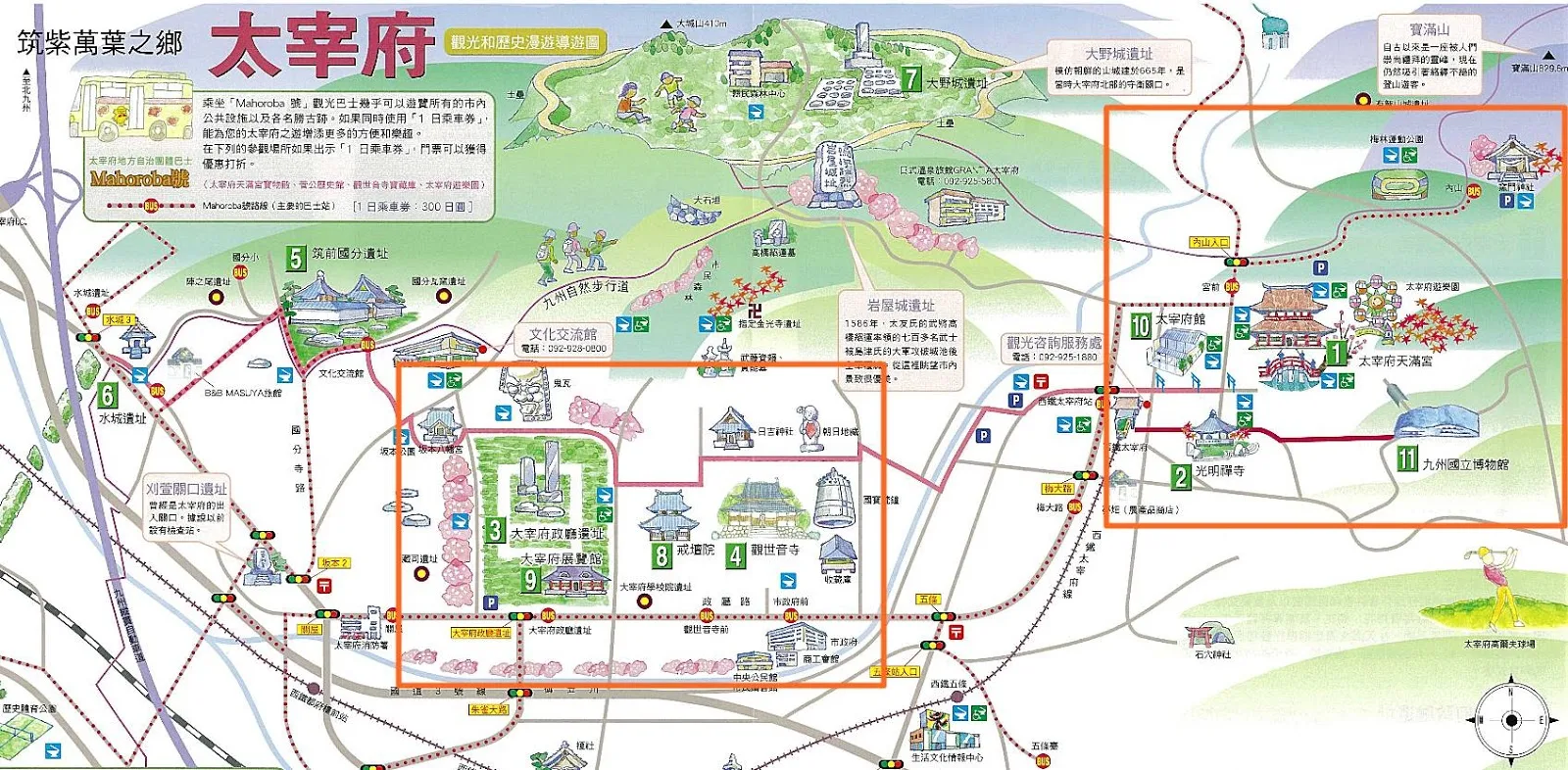
(The main sightseeing clusters around Dazaifu fall neatly into two neighboring areas, making travel between them very manageable.)
1. Homangu Kamado Shrine
Unlike Dazaifu Tenmangu, Kamado Shrine was founded to pray for state protection and national harmony. It enshrines Tamayori-hime, mother of Japan's legendary first Emperor Jimmu, and is revered as a guardian of matchmaking and relationships ("en-musubi"). If Dazaifu Tenmangu is celebrated for plums, Homangu Kamado Shrine is Dazaifu's top spot for springtime cherry blossoms and fiery autumn foliage. If the season aligns, it is a must-visit!
◎ Address: 883 Uchiyama, Dazaifu, Fukuoka (Homangu Kamado Shrine)
◎ Admission: Free
◎ Access: Take the Mahoroba-go Uchiyama Line (Gray Line) to the final stop "Uchiyama" (Kamado Jinja-mae)
◎ Official Website: Homangu Kamado Shrine
◎ Nearby Accommodation: Booking︱Agoda︱Hotels︱Expedia (Compare Rates | Recommended Stays)


(Beside the shrine stands a remarkably sleek, modern amulet pavilion. Outside lies an observation deck overlooking the valley—fabulous during cherry blossom and maple foliage seasons. The stylish circular rotating benches outside were designed by renowned British industrial designer Jasper Morrison.)


(The shrine exudes tranquil serenity, and you may even spot deer roaming peacefully. In recent years, due to the mega-hit anime "Demon Slayer: Kimetsu no Yaiba," anime fans have flocked here on pilgrimage because the shrine shares its name with protagonist Tanjiro Kamado! Anime fans shouldn't miss it!)
2. Kanzeonji Temple
Commissioned in the 7th century by Emperor Tenji, Kanzeonji was historically one of only three temples in all of Japan authorized to perform formal Buddhist ordinations (kaidan). The temple houses remarkable historic Buddhist statues designated as national cultural properties, while its bell tower holds Japan's oldest existing temple bell (Bonsho), forged in the late 7th century. A deeply historic and tranquil Buddhist landmark!
◎ Address: 5-6-1 Kanzeonji, Dazaifu, Fukuoka (Kanzeonji Temple)
◎ Admission: Grounds free; Treasure House (Homotsuden) Adults 500 JPY, College/High School 300 JPY, Elementary/Junior High 150 JPY
◎ Access: Take the Mahoroba-go Uchiyama Line (Gray) or Line 5 (Orange) bus to "Kanzeonji-mae" stop
◎ Official Website: Kanzeonji Temple
◎ Nearby Accommodation: Booking︱Agoda︱Hotels︱Expedia (Compare Rates | Recommended Stays)


3. Kyushu National Museum
Situated right beside Dazaifu Tenmangu, the Kyushu National Museum is one of Japan's four national museums. Its expansive curved-glass exhibition halls preserve invaluable historical artifacts illustrating Japan's cultural exchange with other Asian nations, alongside Dazaifu's pivotal heritage. History and archaeology buffs will love this stop!
◎ Address: 4-7-2 Ishizaka, Dazaifu, Fukuoka (Kyushu National Museum)
◎ Admission: Adults 700 JPY; University students 350 JPY; High school students and below Free (Klook Discount Tickets)
◎ Access: About a 10-minute walk from Dazaifu Station (accessible via the covered moving walkway from Dazaifu Tenmangu)
◎ Official Website: Kyushu National Museum
◎ Nearby Accommodation: Booking︱Agoda︱Hotels︱Expedia (Compare Rates | Recommended Stays)

(Travelers can also pick up the 1,000 JPY "Dazaifu Three-Museum Pass", granting combined admission to Kyushu National Museum, Kanko Historical Museum, and the Treasure Hall—a smart purchase if you plan to visit all three! [Photo by そらみみ via Wikimedia Commons])
4. Dazaifu Government Office Ruins (Dazaifu Seicho-ato)
In ancient times, Dazaifu was the administrative, military, and diplomatic hub overseeing all of Kyushu, affectionately dubbed the "Western Capital" (Saifu). The Dazaifu Government Office Ruins mark the historic site of this vast administrative complex. Compared to other historical castle ruins in Japan, visible structures are minimal—chiefly foundation stones set in a spacious lawn. Unless visiting during cherry blossom season, casual travelers might find it quiet; visit if you have spare time and an interest in ancient history.
◎ Address: 4-6-1 Kanzeonji, Dazaifu, Fukuoka (Dazaifu Government Office Ruins)
◎ Admission: Free
◎ Access: Take the Mahoroba-go Uchiyama Line (Gray) or Line 5 (Orange) bus to "Dazaifu Seicho-ato" stop
◎ Official Website: Dazaifu Seicho-ato (Government Ruins)
◎ Nearby Accommodation: Booking︱Agoda︱Hotels︱Expedia (Compare Rates | Recommended Stays)


That concludes our complete guide to Fukuoka's Dazaifu Tenmangu Shrine, covering transit, food, routes, and surrounding highlights! Dazaifu is wonderfully suited for a relaxed half-day or full-day outing (and pairs delightfully with a boat cruise in Yanagawa). Timed with the right season, you'll be treated to spectacular blooms of plums, cherries, or autumn leaves. Next time you're in Fukuoka, make sure to carve out time for Dazaifu!