
Melbourne Public Transport Guide: Everything You Need to Know
Melbourne is Australia's second-largest city, blessed with an incredibly convenient transit network. Simply by taking trams, trains, and buses, you can easily reach all the major attractions across downtown Melbourne and its suburbs.
In this post, I have gathered all the essential public transit information you need whether you are traveling, on a working holiday, or studying in Melbourne. Covered below are the transit networks, fare structures, timetables, route maps, boarding etiquette, and an in-depth walkthrough of Victoria's contactless transit pass, the myki card—helping you navigate Melbourne like a local!

(Beyond renting a car and driving yourself, Melbourne's public transport can already take you to most popular attractions!)
1. Overview of Public Transport Modes
All public transit options in Melbourne are coordinated by Public Transport Victoria (PTV), primarily comprising four modes: trams, trains, buses, and ferries. Here is a quick introduction to each:
| Mode | Introduction |
| Tram | The backbone of transport in downtown Melbourne. Trams are split into standard trams and the heritage City Circle Tram (Route 35). The only main differences are slightly adjusted service hours and an onboard audio commentary on the City Circle line. Trams reach almost every top Melbourne city attraction, including Queen Victoria Market, Flinders Street Railway Station, and Melbourne Central. |
| Route Map | Timetable | |
| Train | Mainly used for longer-distance journeys. Trains cover a wide geographic area and feature automated stop announcements. They take you directly to suburban spots such as the Melbourne Zoo and the famous Puffing Billy Railway. |
| Route Map | Timetable | |
| Bus | Less commonly used by standard tourists, as only a few outer suburban spots require a bus transfer. Buses generally do not have audio stop announcements, so you need to track your location on a map. |
| Route Map | Timetable | |
| Ferry | There are only 3 routes with fares priced separately; they do not accept myki cards or standard transit rules. You will likely only use them for specific destinations such as Phillip Island. |
| Route map, fares, and timetables: Click here |
Now that you know the transport modes, it is crucial to understand that Melbourne's transit network—whether tram, train, or bus—is priced strictly by "Zone", meaning the fare does not vary by transit mode. The metropolitan area is currently divided into three zones: the Free Tram Zone, Zone 1, and Zone 2, while regional areas extend outward from Zone 3 to Zone 13, detailed below:

This is the tram network map. The grey-green shaded area in the city center represents the "Free Tram Zone," where riding any tram is completely free (trains and buses within this zone still require a fare). Moving outwards, you encounter Zone 1 and the Zone 1/2 overlap; trams do not run into regional zones.
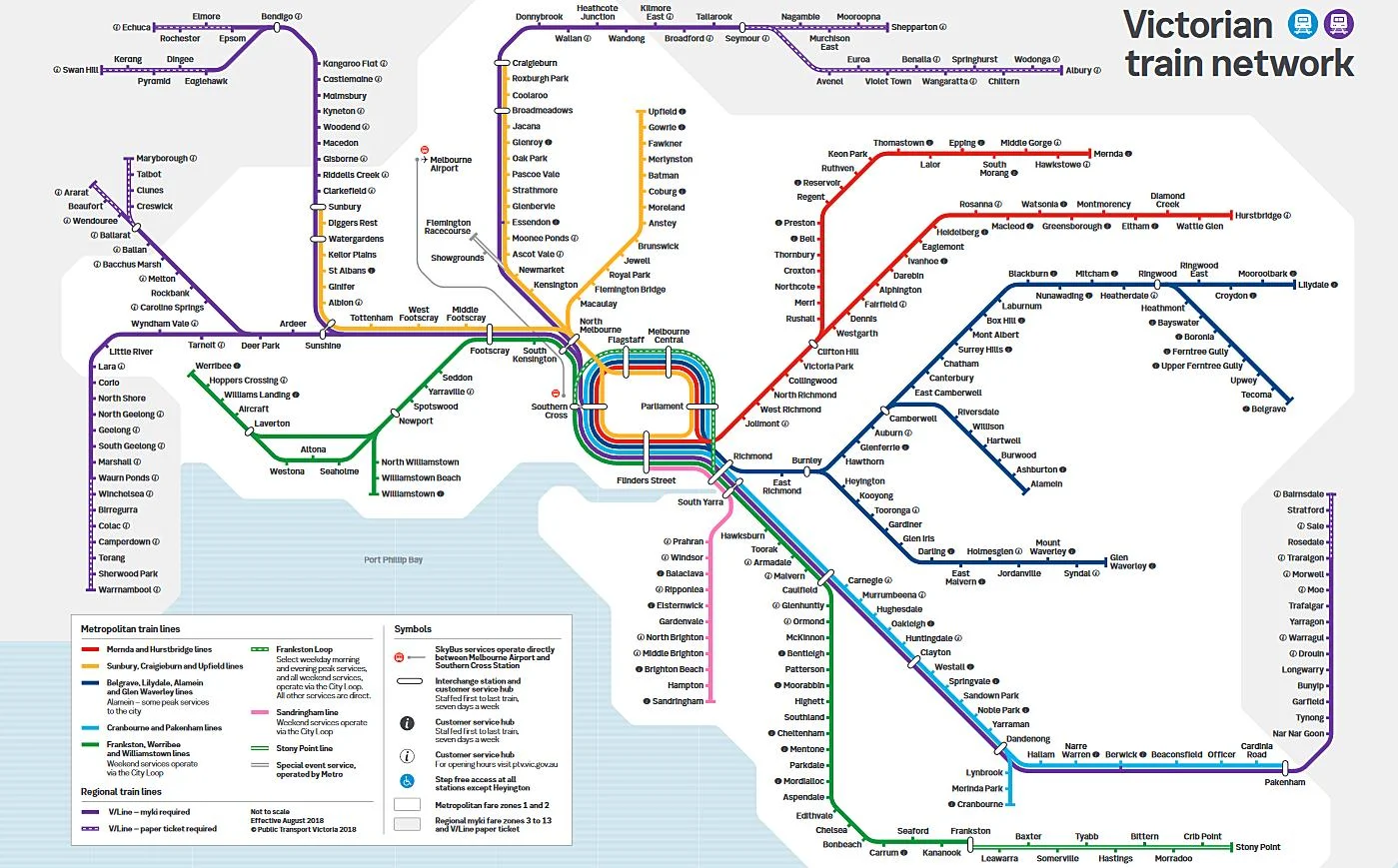
This is the train network map, divided into Metropolitan lines (white background, spanning Zone 1 to Zone 2) and Regional lines (grey background, extending through Zone 3 to Zone 13). Furthermore, the starting and terminal hub for all suburban lines is Flinders Street Station, which loop around the city center through what is known as the City Loop.
As for buses, routes also span from Zone 1 to Zone 13. You can refer to the Metropolitan Bus Route Map and the Regional Bus Route Map.
Once you understand the zoning basics, make sure to use PTV's official Journey Planner. Simply input your departure point, destination, travel time, and preferred transit modes to get all-in-one transit guides, travel times, fares, and routing maps similar to Google Maps—an indispensable tool for getting around Melbourne!
2. The myki Card
Now let's dive into the most important part of this guide!
Just like Queensland has its Go Card and Sydney uses the Opal Card, Melbourne has its own smart transit card: the myki Card. Except for a few remote regional train stations, paper single tickets have been completely phased out—everyone must use a myki card! Here are the key questions and answers to keep in mind:
Q1: What types of myki cards are available and how much do they cost?
There are 4 main types: Full Fare (Adult), Concession, Child, and Senior. The Full Fare adult card costs AUD $6, while the other three cost AUD $3. Eligibility rules are as follows:
- Full Fare (Adult): Adults aged 19 and older, including international tourists
- Concession: Local Victorian students, people with disabilities, and seniors from other Australian states
- Child: Children aged 5 to 18 (children aged 4 and under travel free and do not need a card)
- Senior: Victorian seniors card holders

Q2: How does myki fare calculation work? Are there fare caps and discounts?
When loading credit onto your card, you have two fare models to choose from:
1. myki Money: Pay-as-you-go credit. Ideal for short-term visitors making occasional trips. Tapping on grants you a 2-hour travel window within your zones. If you tap on again after 2 hours, it deducts a second fare and automatically caps into a Daily Fare—meaning you will never be charged more than twice per day.

(For myki Money, the 2-hour rate on weekends and public holidays is the same as weekdays, but the daily cap drops to around AUD $7.60 or $3.80, making weekend travel even cheaper!)
2. myki Pass: Period pass, available as a 7-day pass or 28 to 325-day passes. The validity period starts counting down from your first tap. Perfect for long-term commuters or students, loaded in increments of days or weeks.

(If you purchase a 325 to 365-day myki Pass, you only pay for 325 days, effectively giving you up to 40 days of free travel per year!)
Finally, traveling past Zone 3 enters regional fare brackets, which you can check on the Regional Fares Table. However, as seen on the map above, all tram lines stay entirely within metropolitan zones; only very remote buses or regional trains incur regional fares, so ordinary tourists rarely encounter them.
Q3: Are there any other myki perks or discounts?
If you touch on using myki Money after 6:00 PM on any day, you will be charged the standard 2-hour fare, but travel is valid until 3:00 AM the next morning without further charges. Furthermore, touching on and off before 7:15 AM on weekday mornings across Metropolitan train lines is completely free (Early Bird train travel).
Q4: How do I touch on and off with myki?
Except when riding trams inside the Free Tram Zone where you do NOT touch on at all, you MUST touch on and touch off on every train and bus trip, regardless of the zone.
If you ride a tram that travels outside the Free Tram Zone, you only need to touch on when boarding; touching off when getting off is optional.

(Many stations in Melbourne do not have physical ticket barriers. However, if ticket authorized officers catch you riding without touching on, the on-the-spot penalty fine is roughly AUD $240—so always touch on honestly!)
Q5: Where can I buy and top up a myki card?
- Melbourne Airport (SkyBus terminals and retail outlets)
- Major newsagencies and convenience stores (e.g., 7-Eleven)
- Station self-service top-up machines (can only purchase Full Fare adult cards)
- Google Pay digital wallet (currently for Android users only)
- Station ticket offices
- PTV Hubs
- Phone order via 1800 800 007 (takes about 7 business days to deliver)
- Official PTV website to buy online or top up online (you can also register your card online to view balance, track travel history, and protect your funds if lost)
- Onboard buses (cash only, maximum AUD $20 change) ※Note: Trams do NOT sell or top up myki cards!

(Automated myki machines are located at major stations across Melbourne for both card purchases and top-ups.)
Q6: How can I get a refund for my leftover myki balance?
You can apply online (physical cards must be mailed to Mailbox, Reply Paid 4318, Melbourne VIC 8060), visit a PTV Hub, or call 1800 800 007 to request a refund. You can also transfer remaining myki Pass days into myki Money value (calculated from the day of application, not the last day traveled).
Q7: Do I really need to buy a myki card?
If you are visiting for a short trip and solely stay within the Free Tram Zone, you do not need to buy a myki card at all, since touching on is unnecessary and most downtown highlights are reachable by tram. However, if you plan to venture into the inner suburbs or day-trip destinations without driving or joining a tour—or if you are staying in Melbourne long-term for study or a working holiday—buying a myki card is definitely essential.

(When waiting for a tram, there is no need to hail the driver; simply wait at the platform and it will stop. To get off, press the stop button. On older heritage trams, you will see blue cords hanging above the seats—just give the cord a gentle tug.)
3. Key Travel Tips & Reminders
1. Transit cards in Australia are state-specific and cannot be shared across borders. Brisbane's Go Card and Sydney's Opal Card cannot be used in Melbourne, nor can Melbourne's myki card be used in other Australian cities.
2. If you touch on and touch off at the very same train station within 15 minutes, you will not be charged (so don't worry if you accidentally enter the wrong station; just tap out within 15 minutes).
3. A myki card can hold both myki Money and a myki Pass at the same time. If both have valid balances, the system will prioritize using your myki Pass first.
4. If you have an active myki Pass covering metropolitan zones (Zone 1 & 2) and travel beyond that boundary, the system will automatically deduct the extra fare from your myki Money balance. If you travel further to remote stations where myki is not accepted, you must buy a paper ticket.
5. If you forget to touch off when exiting a train station, the system will default to charging a 2-hour fare corresponding to the furthest zone on that line. For instance, if you board a regional train in Zone 1 and get off in Zone 2 without touching off, you will be penalized with a charge up to Zone 13.

That covers everything you need to know about navigating Melbourne's public transport system! Compared to many other Australian cities, Melbourne's transit network is wonderfully accessible and easy to use for tourists, students, and working holidaymakers alike. If you found this guide helpful, don't forget to share it with your fellow travel companions!