
Okinawa Car Rental | Ultimate Road Trip Guide
Renting a car for a self-drive road trip is arguably the best and most highly recommended way to travel around Okinawa. Exploring Okinawa by car saves precious time, gives you maximum flexibility, and makes it wonderfully easy to reach various Okinawa attractions. Plus, if you are traveling with friends or family, the total cost split between passengers is surprisingly affordable.
In this comprehensive guide, I will walk you through everything you need to know about renting a car in Okinawa: rental requirements, recommended car rental companies, costs, price comparison sites, and insurance options. I'll also share our actual step-by-step rental process and driving experience on the road. I'm confident this will make your Okinawa self-drive holiday completely stress-free!

1. Okinawa Car Rental Companies
Because Okinawa is one of the most popular road trip destinations in Japan, there is a wide range of rental car providers. However, the 6 mainstream companies most travelers choose are OTS, Times, ORIX, Toyota, Nippon, and Nissan.
These major rental brands generally offer more branches (including airport stores), easier pickup and drop-off, longer business hours, comprehensive insurance packages, multilingual support, and superior vehicle and customer service quality—making them our top recommendations. While dozens of smaller local rental shops operate across Okinawa offering cheap rates, their pickup/drop-off locations are very limited, and fleet quality, vehicle models, and insurance protections are often substandard, so I usually don't recommend them for international tourists.
To give you a clear overview of these top rental brands, here is a detailed comparison table covering services, airport shuttles, and optional fees across the 6 major Okinawa car rental companies:
| Company | OTS | Times | ORIX | Toyota | Nippon | Nissan |
| Free Shuttle | All provide free airport shuttle service | |||||
| Pickup Area | International Terminal Stop | Domestic Terminal Stop | ||||
| Airport Drive (Min) | 15 | 3 | 15 | 5 | 15 | 10 |
| Chinese Website | Yes | Yes | Yes | Yes | Yes | Yes |
| Chinese Staff | Yes | Yes | No | No | Yes | Yes |
| Business Hours | 08:00 - 19:00 |
08:00 - 20:00 |
09:00 - 19:00 |
08:00 - 20:00 |
09:00 - 20:00 |
08:00 - 20:00 |
| Branches | 5 | 6 | 27 | 9 | 4 | 6 |
| Child Safety Seat | ¥1,100 | ¥550 / ¥1,100 | ¥1,100 | ¥550 | ¥1,100 | ¥550 |
| ETC Card | ¥330 | ¥330 | ¥330 | ¥330 | ¥330* | ¥330 |
| Key Highlights | Excellent reviews Caters to overseas tourists Frequent promotions Diverse vehicle choices Affordable |
Closest to airport Member specials Fewer locations Competitive pricing |
Most widespread network in Okinawa Cheap insurance 5% official site discount LCC partnerships Seasonal deals |
Largest fleet in Japan Higher rates Platform partnerships (e.g., KKday / Klook) Basic multilingual site |
3rd largest in Japan Member discounts Platform partnerships (e.g., KKday / Klook) Afternoon rental plans |
5% discount on Japanese site Short rental options (from 3 hours) |
| Notes | ※ Lists select promotional campaigns and plans. ※ All rental companies provide GPS navigation with multilingual / Chinese voice guidance. ※ Nippon ETC card rental is ¥330 within 7 days, and ¥1,100 for 8 days or more. ※ All terms are subject to change according to official websites. ※ One-way drop-off fees depend on distance or are free within 20 km. Since most travelers pick up and return cars at airport branches or within Naha city (where returns between different urban branches are typically free), one-way fees rarely apply in Okinawa. |
|||||
As you can see from the comparison table, several Okinawa car rental companies pick up travelers outside the Domestic Terminal. Although the Domestic and International Terminals are easily walkable within 5 minutes, OTS, Times, and ORIX pickup directly at the International Terminal, which is undeniably the most convenient. If your priority is being as close as possible to the airport to maximize your sightseeing time, Times and Toyota are top picks. As for operating hours, ETC card rentals, and child seat costs, differences between providers are very minor.
In addition to the major companies above, there is also a specialty rental agency named Grace Okinawa. Their unique appeal is exclusively offering imported luxury vehicles and premium performance sports cars, including convertibles, coupes, and executive sedans. If you dream of cruising Okinawa's coastal roads in a convertible sports car, Grace Okinawa is without doubt the top choice! Plus, there is a gas station right next door, which makes refueling on return effortless.

2. Okinawa Car Rental Costs
Once you know the main companies, the next natural question is: Which rental car company is the cheapest? The short answer is: No single company is always the cheapest!
Car rentals in Okinawa are generally billed either by "calendar day (per day)" or by "hourly block (24-hour cycle)", with the latter usually working out cheaper. Moreover, promotional deals and seasonal coupons vary constantly, and each traveler has different requirements regarding rental duration, child seat needs, and insurance packages, all of which alter the final price.
A solid rule of thumb to lock in low rates is to book as early as possible (at least 1 to 2 months in advance). Most providers offer "Early Bird Discounts" (Hayawari) that slash rates considerably. Furthermore, if you understand Japanese, compare rates on the company's Japanese site, as exclusive domestic deals are sometimes cheaper than foreign-language portals.

3. Okinawa Car Rental Comparison Platforms
Comparing every individual rental website manually can be tedious. To save time and get the best deal, using a comparison platform is by far the easiest route. Here are the 6 best Okinawa car rental comparison websites: Rentalcars.com, Klook, Gogoout, Tabirai, ToCoo!, and Car Rental.com (租車網.com).
| Comparison Site | Overview |
| Rentalcars | The world's largest car rental search engine. Quickly aggregates rates across major Okinawa rental companies, especially international chains. Offers standalone full insurance at rates often lower than the rental counter, and provides free cancellation up to 48 hours before pickup. |
| Klook Car Rental | A leading travel booking platform for tours, tickets, and activities that also features a powerful car rental search tool across top Okinawa providers. Applying active Klook promo codes can unlock extra savings! |
| ToCoo! | One of Japan's largest domestic rental car booking platforms. Its standout feature is bundling vehicle rentals with essential gear like ETC cards, Wi-Fi routers, and its proprietary Expressway Pass, often delivering fantastic package value. |
| Gogoout | Taiwan's largest online car rental booking aggregator, covering multiple international destinations including Okinawa. Pricing and user reviews are transparent, and Mandarin customer service removes communication hurdles. Register via our exclusive promo link to get an extra NT$300 rental credit! |
| Tabirai | Founded originally in Okinawa, Tabirai excels at local Okinawa car rental deals. Designed specifically with international tourists in mind, its interface is clear, clean, and upfront with pricing. Listed rates already include basic CDW insurance, and it frequently undercuts direct official site prices. |
| Car Rental.com | A prominent Japanese car rental aggregator featuring a great mix of major brands and regional local suppliers. Features a full Traditional Chinese portal and responsive Mandarin online support. |

(As highlighted in my guides to Fukuoka car rental and Hokkaido car rental, prices fluctuate with seasonal demand, vehicle type, and promotions. Using a price comparison engine is the quickest way to see live rates and bag the best deal.)
4. Okinawa Car Rental Insurance Explained
When booking a car rental in Japan, insurance coverage mainly falls into two categories: Basic Mandatory Insurance and Optional Add-On Insurance. Basic insurance, officially termed the Insurance Compensation System (Hoken Hoshō Seido), is legally mandated and automatically included in all base rental quotes. In an accident, it covers the bulk of third-party liability, property damage, and vehicle loss, leaving the driver responsible only for a minimum deductible (excess/Jikofutankin).
To waive this deductible, companies offer optional coverage known as the Collision Damage Waiver (CDW / Menseki Hoshō Seido). Purchasing CDW completely waives your out-of-pocket deductible for third-party injury, property damage, and vehicle repairs.
However, if an accident renders the car undrivable, stolen, or requires cleaning/repair, the rental company loses business during downtime. In Japan, they will charge you a Non-Operation Charge (NOC), typically ranging from ¥20,000 to ¥50,000. Even with standard CDW coverage, you are still liable for this NOC!
This led to the creation of premium coverage—commonly called Peace of Mind / Premium Protection (Anshin Pack). While each rental agency names it differently, it essentially functions as Full Comprehensive Coverage (Zero Excess). It completely waives both the deductible and the NOC, while often bundling 24/7 roadside assistance, emergency tire changes, jump-starts, and fuel delivery.

(Comparison of different rental insurance coverage levels)
How much does car insurance cost across rental providers in Okinawa? Here is a breakdown of insurance plan names and daily rates for the 6 major companies:
| Company | CDW Plan Name | CDW Daily Cost | Full Cover Name | Full Cover Daily Cost |
| OTS | Collision Damage Waiver* | ¥1,650* | Anshin Pack* | ¥2,200 / ¥2,750 / ¥3,850* |
| ORIX | CDW (免責補償制度) | ¥1,100 / ¥2,200 | Rent-A-Car Anshin Pack (RAP) | ¥1,760 / ¥3,520 |
| Times | Safety Package | ¥1,100 / ¥1,430 / ¥2,200 | Super Safety Package | ¥2,200 / ¥2,530 / ¥3,300 |
| Toyota | CDW (免責補償制度) | ¥1,100 / ¥2,200 | Anshin W Plan | ¥1,650 / ¥2,750 |
| Nippon | CDW (免責補償制度) | ¥1,100 / ¥1,430 / ¥2,200 | Extra Coverage Option* | ¥1,540 / ¥1,870 / ¥2,640 |
| Nissan | CDW (免責補償制度) | ¥1,650 / ¥2,200 / ¥2,750 | Full Support Plan | ¥2,200 / ¥2,750 / ¥3,300 |
| Notes | ※ OTS mandates CDW inclusion in bookings. Its Anshin Pack comes in three tiers (Basic, Premium, Royal), all waiving NOC; price variations depend on roadside rescue perks and extra benefits rather than car model. ※ Rates reflect standard 24-hour pricing including tax across standard compact cars, mid-size/minivans, and larger vans/commercial vehicles. ※ Full protection prices listed represent the combined total of CDW + NOC waiver. ※ Nippon's Extra Coverage Option (¥440) specifically waives NOC and must be paired with CDW for full protection; the total bundled rate is shown. ※ Insurance periods are billed per 24 hours (partial increments under 24 hours count as a full day). |
|||
As indicated above, if you opt for CDW only on standard sedans, ORIX, Times, Toyota, and Nippon are the most budget-friendly. When upgrading to total peace of mind (CDW + NOC waiver), ORIX, Toyota, and Nippon provide the best value for compact cars.
Additionally, purchasing standalone full protection via aggregators like Rentalcars.com can be up to 40% cheaper than buying directly at the car rental desk. The primary procedural difference is that if damage occurs, you pay the rental agency first and submit a reimbursement claim through the third-party insurance portal afterward.

(All major rental agencies offer Full Protection packages bundling basic and complete damage waivers. I personally always insist on getting full coverage—travel is meant for relaxation, and dealing with repair disputes or unexpected out-of-pocket costs after an accident ruins a holiday. Zero excess makes driving completely stress-free.)
5. Okinawa Expressway Guide
Next up is navigating the Okinawa Expressway. Compared to the Japanese mainland, Okinawa's land area is relatively compact. In fact, there is essentially only one primary expressway traversing the main island north to south (along with short connecting spurs), spanning roughly 57.3 kilometers. It is mostly used for driving swiftly between Naha/the south and northern scenic spots like Nago. If you prefer cruising along coastal roads from one nearby town to the next, you may hardly need to use the expressway at all.

In Japan, expressways are known as Jidōshadō (有料道路 / toll roads). Tolls on the Okinawa Expressway are distance-based, ranging from ¥170 to ¥1,020 per trip for standard passenger cars.
How do toll booths work? Toll gates feature Manual Lanes (一般), dedicated ETC Lanes (ETC専用), and Combined Lanes (ETC/一般). If using a manual cash lane, collect a toll ticket from the automated dispenser at the entry gate, and upon exiting, hand your ticket to the attendant or insert it into the payment machine to pay via cash or credit card. If you rented an ETC card with your vehicle, simply slow down to under 20 km/h and glide through the ETC gate—the barrier lifts automatically and tolls are settled at the rental desk upon car return.

(Toll plaza overhead gantries clearly indicate General Manual Lanes, dedicated ETC Lanes, or Mixed Lanes.)
Unlike mainland regions, NEXCO does not issue an official government-backed Okinawa Expressway Pass. Instead, select rental companies or portals (such as OTS or ToCoo!) offer their own private unlimited expressway passes, allowing unlimited driving on the Okinawa Expressway for a fixed consecutive fee. This is beneficial if you plan multiple long-distance north-south round trips. However, it's wise to map out your itinerary beforehand and check tolls on the official expressway toll calculator to ensure you actually save money.
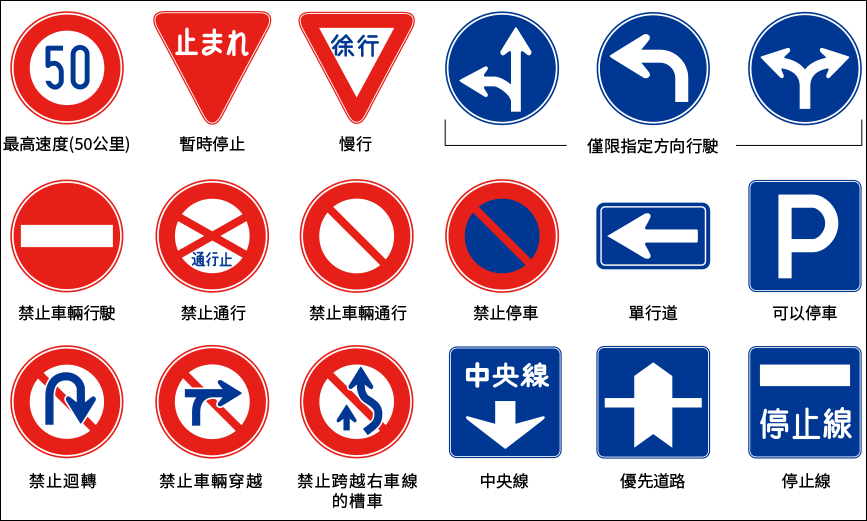
(Common Japanese road and traffic signs you will encounter while driving in Okinawa)

(Expressway speed limits for standard cars in Okinawa are generally 80–100 km/h, while urban streets range from 40–60 km/h. In my experience, locals frequently cruise slightly above the posted speed limits (haha!). Chatting with local friends confirmed that as long as everyone maintains a safe following distance, a modest flow with traffic is customary. However, foreign tourists unfamiliar with local roads should strictly obey the posted speed limits!)
6. Required Documents for Driving in Okinawa
Requirements for renting a car in Okinawa are straightforward. Thanks to reciprocal driving agreements, visitors from countries like Taiwan only need to present: Original Passport, Original Domestic Driver's License, and an Official Japanese Translation of the License. This permits legal driving for up to 1 year from the date of entry into Japan. If you reserved online in advance, also bring your booking confirmation voucher and a credit card in the primary driver's name.
For Taiwanese drivers, the Japanese translation can be obtained at any Motor Vehicles Office in Taiwan by presenting your original license, National ID, and NT$100. Make sure your physical license is not expired before applying.

7. Step-by-Step Car Rental Experience in Okinawa
Here is my exact car rental walkthrough in Okinawa. After comparing rates across platforms, I booked a car with OTS. Regardless of which company you choose, the standard procedure is almost identical, so this guide will prepare you well.

(Rental companies do not have operational pickup desks inside the terminal building. Instead, all major agencies provide free shuttle transfers. Whether arriving at the International or Domestic Terminal, head outside to the long covered bus median across the driveway. Representatives holding rental company signs will greet you. Terminals are only a 5-minute walk apart. For layout details, see my Naha Airport Guide.)


(After checking in with the shuttle staff, you will receive your check-in queue number and driving information booklets. Staff will help load heavy luggage onto the bus. Don't worry if flight delays or immigration lines take longer than expected—shuttles run continuously until every reserved customer has arrived.)

(Upon arriving at the rental depot, present your booking confirmation, original driver's license, translation or IDP, and passport. Review and sign the contract, and complete payment via cash or credit card. Some agencies place a temporary card pre-authorization hold as a security deposit for tolls or damage deductibles, which is released on return. OTS does not require a deposit. If you haven't added full insurance or extras like child safety seats, you can still add or upgrade them right here at the counter.)


(Once paperwork is finalized, staff will hand you your payment receipt and vehicle inspection sheet before walking you over to your car. Together, you will inspect the vehicle exterior. Any pre-existing scratches, scuffs, or dents will be noted on the sheet. If you spot anything unmarked, point it out immediately so they can record it before you hit the road.)

(Driving in Japan is on the left side of the road with right-hand drive vehicles. It takes a few minutes to get used to the wiper and indicator controls, but outside of downtown Naha's rush-hour traffic, driving around Okinawa is exceptionally pleasant and peaceful. Roads are well-paved, traffic is courteous, and navigation rules are easy to follow (see Japanese Road Signs).)
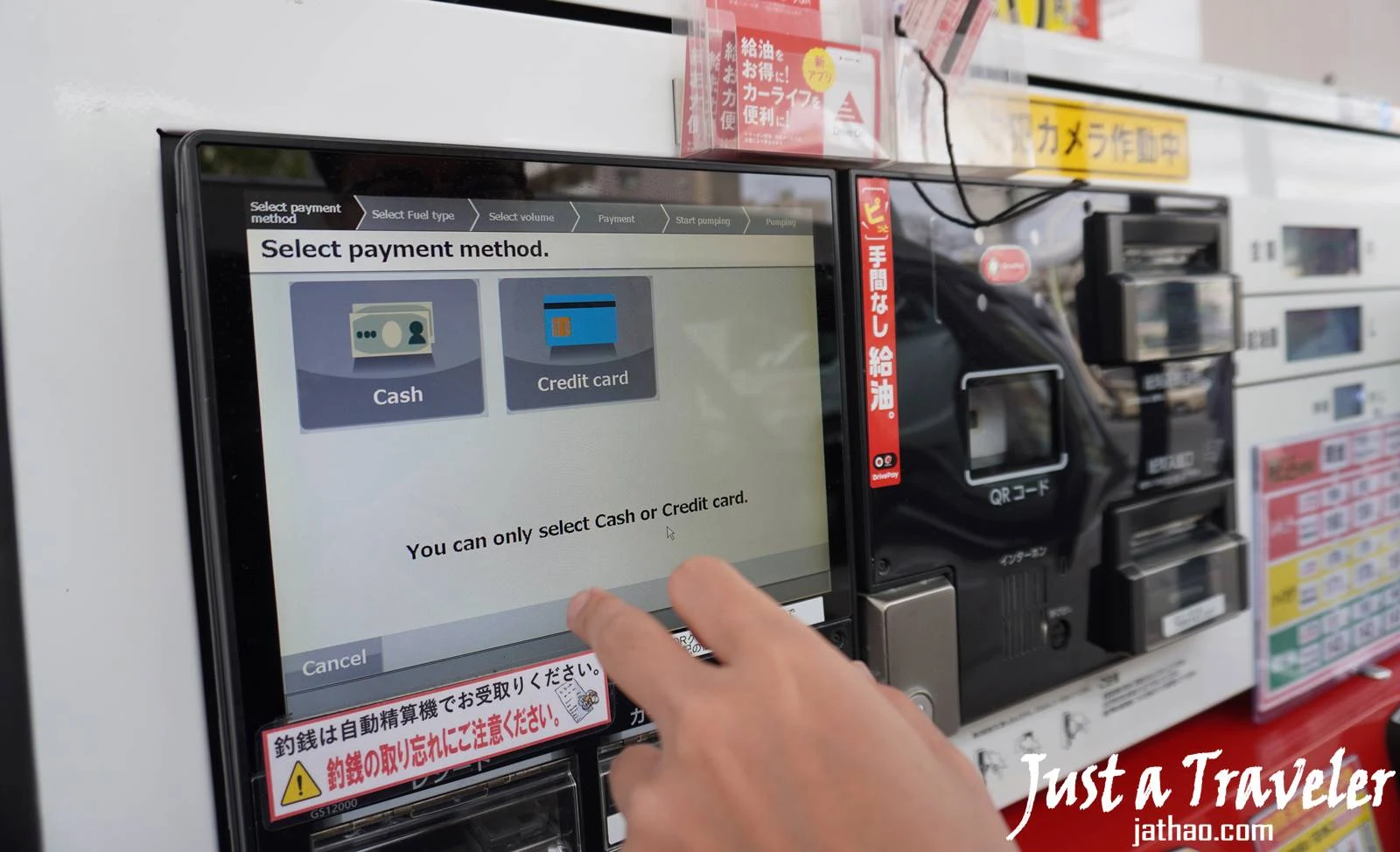


(Many gas stations in Okinawa are self-service. Park beside a pump and use the touch-screen terminal, which usually supports English. Refueling involves 5 simple steps: select payment method, choose fuel type (Regular gasoline / red nozzle for standard rental cars), specify volume/fill-up, pay by cash or credit card, and pump. If paying with cash and change is due, the machine will print a barcode voucher [Tsuri-sen Azukarikensho]. Take it over to the adjacent automated change machine [Seisanki], scan the barcode, and your coins/notes and receipt will drop out.)

(Outside of Naha city center, parking across Okinawa is overwhelmingly free at most attractions and shopping malls. In central Naha, parking lots typically charge ¥100–¥400 per hour depending on prime location and time of day, usually featuring a daily maximum fee cap. Pay close attention to board rules—some caps cover consecutive 12 or 24 hours, others apply only during overnight periods, and some reset at midnight.)
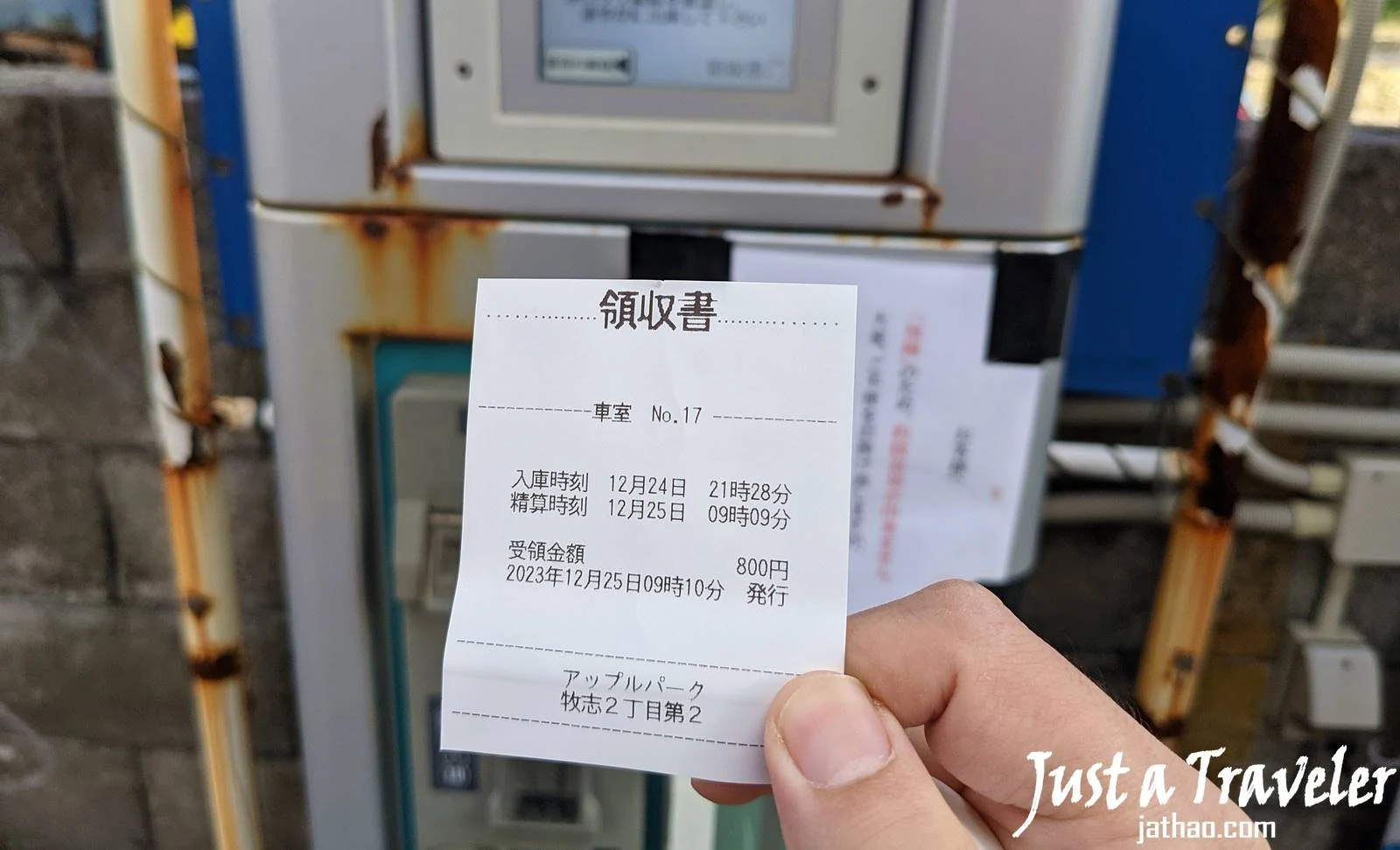
(To exit a flap-lock parking space, walk over to the automated payment machine, key in your parking spot number, and settle the fee. Press the receipt button [領収書] if needed. The ground flap under your car will lower. Make sure to drive out promptly within 3 to 5 minutes, as the barrier flap will rise again automatically.)

(Returning the car is remarkably quick. Staff check the fuel gauge, verify vehicle condition, and take back the keys—our return took barely 3 minutes. Almost all Okinawa rental contracts mandate returning the car with a full tank of gas, so always keep your final petrol station receipt to show staff on return. Once dropped off, board the free shuttle bus back to Naha Airport.)
8. Important Tips & Driving Rules in Okinawa
- Always purchase Full Protection (Peace of Mind / Zero Excess coverage); the security is worth every penny in preventing holiday-ruining liabilities.
- Under Japanese traffic law, children under 6 years old must use an approved child safety seat. Failure to comply is subject to legal fines.
- Certain car rental companies require drivers to be at least 21 years old or levy young-driver surcharges.
- Japanese cars are compact; if traveling with a full passenger load, choose a car one size larger. For example, 5 travelers with full luggage should rent a 7-seater minivan to ensure suitcases actually fit.
- If an accident or scrape occurs, you MUST immediately call the police (110) and notify the rental company. Without an official police accident report (Jiko Shōmeisho), your insurance coverage is completely invalid! (Emergency numbers in Japan are 110 for police and 119 for ambulance).
- After-hours returns (e.g., late red-eye flights) are often supported by prior arrangement, but usually incur a surcharge of around ¥1,100 to ¥2,200.
9. Understanding Japanese License Plates & Driver Decals

Ever wondered what the symbols on car rear ends signify in Okinawa? As shown in the photo above, the hiragana character before the digits and the magnetic sticker on the boot lid reveal fascinating details:
License Plate Color: White indicates standard passenger vehicles; yellow indicates 660cc kei micro-cars.
Kana Prefixes: Plates beginning with "わ" (wa) or "れ" (re) designate rental vehicles. A plate starting with "Y" indicates personnel affiliated with US military bases. Other kana indicate privately owned local Okinawa vehicles.
Driver Decal Stickers:
| Designation | Beginner Driver Mark (Shoshinsha Mark / 初心運転者標識) |
Elderly Driver Mark (Kōreisha Mark / 高齢運転者標識) |
| Symbol |

|

|
| Applies To | Drivers licensed for less than 1 year | Senior drivers behind the wheel |
| Designation | Hearing-Impaired Driver Mark (Chōkaku Shōgaisha Mark / 聴覚障害者標識) |
Physical Disability Driver Mark (Shintai Shōgaisha Mark / 身体障害者標識) |
| Symbol |

|

|
| Applies To | Drivers with hearing impairment | Drivers with physical mobility needs |
(Under Japanese traffic law, other motorists are legally required to give way and exercise extra caution around cars displaying these decals; failing to do so may result in traffic penalties. Courtesy on the road ensures a safer, happier vacation for everyone!)
That wraps up our complete guide to renting a car in Okinawa! If driving isn't your preferred style, Okinawa also offers diverse transportation alternatives such as public transit (Local Buses | Yui Rail Monorail), the convenient Hip Hop Sightseeing Bus, private chartered car tours, or point-to-point airport transfers, so you can tailor your Okinawa holiday exactly to your liking.